

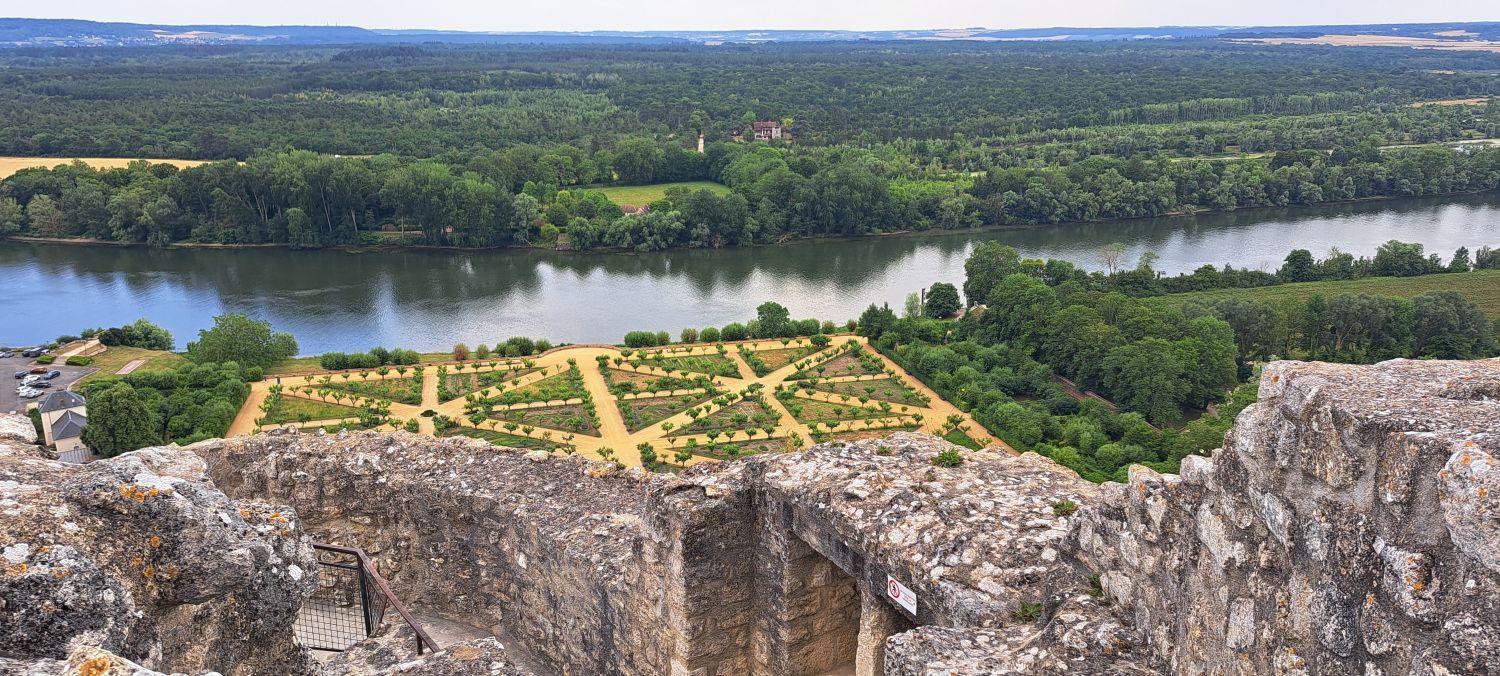
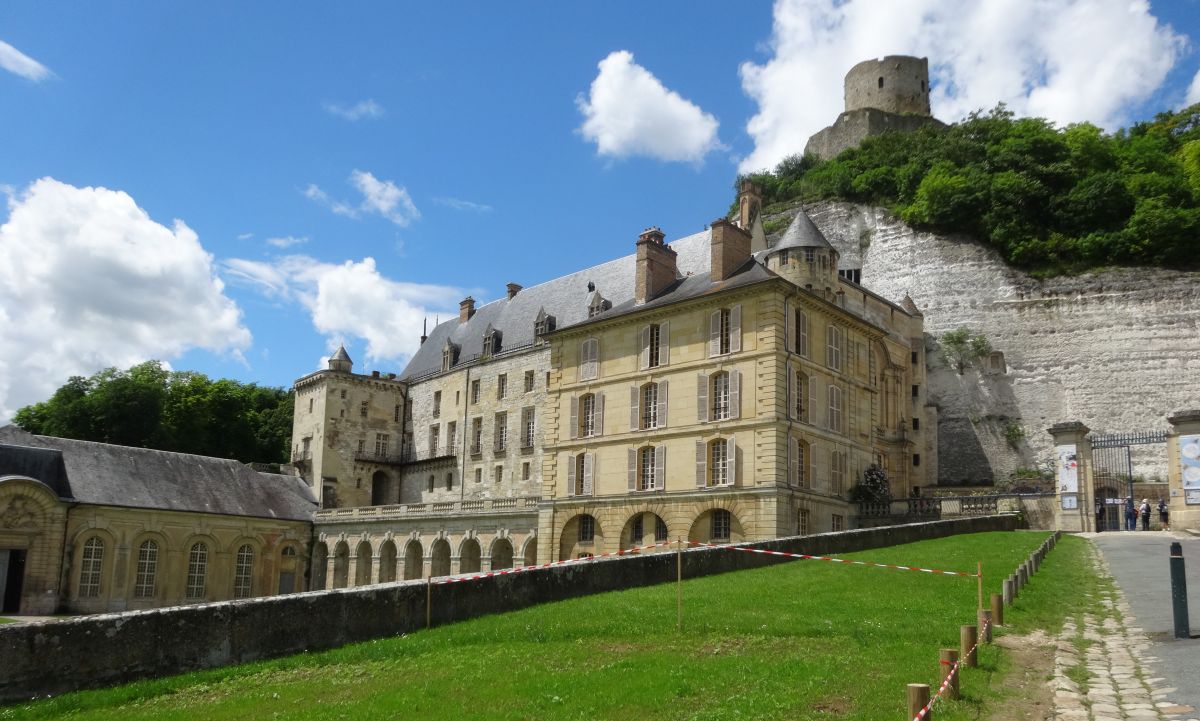
I’ve climbed up for this view at least a dozen times. I start from the floor of river valley, where I admire the multi-era Château de La Roche-Guyon, then follow the slope to the castle entrance and purchase a ticket. Hardly anyone else is ever around. Entering the massive structure, I go up the grand staircase then pass through a succession of empty castle rooms until I reach concealed stairs cut many centuries ago into the limestone cliff. I then climb past the troglodyte pigeon coup and through the winding, uneven medieval tunnel-staircase, until I reach the ruin of the 12th-century castle keep. I then ascend the keep on more regular footing until I reach the truncated top.
Here, I take in the tremendous view over the Seine Valley, at the border between the Paris region and Normandy, border of France its, from above a castle that embodies major events in French, even European, history over the past 1000 years. Since not all who enter the castle are willing to make the climb, the few visitors entering down below are fewer still to share this view.
Each time I’ve made the climb I’ve thought, “That was certainly worth the detour and the effort. Too bad the castle down below is so empty. And too bad no one bothers to inform visitors about the history of this carcass.”
But that isn’t what I thought when I reached the top this summer.
The rewarding view earned after an athletic climb is the same, but La Roche-Guyon, just six miles from Giverny, has now upped its game. An artistic and cultural project that came into fruition this summer marks a turning point for the chateau as several rooms have been graced with historic furnishings and complemented by new works by artists-in-residence. La Roche-Guyon feels less the carcass passageway to the summit and more a place to linger. A site that I used to think as a detour is now en route to becoming a destination.
With 90,000 visitors last year, the Château de La Roche-Guyon is the most visited heritage site in the department (or subregion) Val d’Oise of the Greater Paris region, yet it’s generally off the radar for international travelers. That’s undoubtedly due to the difficulty of access without a car and the absence of organized tours from Paris.
Compare that with the international reputation of Monet’s House and Gardens at Giverny, a wide bend in the river downstream along the Seine and just six miles away by road. Giverny (pronounced shjee-ver-nee) draws over 750,000 visitors per year. Already, in 2014, I suggested to readers planning a visit to Giverny to consider combining it with a stop at La Roche-Guyon. (See that article.) La Roche-Guyon now inspires more than a stop. Indeed, Giverny could now be the “stop” after visiting La Roche-Guyon. More on that toward the end of this article.
From hollowed carcass…
The La Rochefoucauld family has owned the Château de la Roche-Guyon nearly continuously since 1659. Call the current head of the household Duke de La Roche-Guyon if you wish. Though titles that formerly conferred a superior legal status, rights and privileges no longer have judicial significance, they may still used honorifically.
For generations, centuries even, the chateau’s interior maintained the allure of a noble household. Prized paintings, tapestries and furniture decorated the major reception rooms. The vast library held a large, valuable collection of books. Curiosities filed shelves in an adjacent room. The death of a proprietor duke in 1964 then of his duchess in 1984 put an end to that. Rather, the inability of heirs to agree to a less dramatic way to pay the inheritance tax than selling most of the furnishings did. The historic rooms were emptied. Their contents were taken to Sothby’s auction block in 1987, leaving a tremendous void to increasingly decrepit spaces. La Roche-Guyon became a decaying carcass of a castle.
… to public funding and restoration
A branch of the La Rochefoucauld family still owns the chateau. The family has private apartments on the upper floors, which can’t be visited. Much of the rest, however, is open to the public since the chateau has been managed and enriched by over 30 years by a public entity working under the auspices of Val d’Oise and other local administrations. Throughout France, such multilayered arrangement allows certain privately owned heritage sites to be maintained and open to the public so as to continue to be a part of the cultural landscape for more than a simple drive-by view,
Restoration of the château was the main objective in the 1990s. I made my first visit in the mid-90s, soon after it had opened to the public. The pervasive feel was of a hollow carcass, but at least it was now receiving funding for repair and could be visited. The 2000s saw the replanting and recreation of the chateau’s kitchen garden and orchard in its 18th-century configuration. Situated across the street from the chateau, that 9.4-acre enclosed garden/orchard is the second largest of its kind in the Paris region, after the Potager du Roi, the royal kitchen garden at Versailles. It earned the national label Jardin remarquable (Remarkable Garden) in 2011. By then, attention was slowly turning to refurnishing the succession of 18th-century rooms that had been emptied in 1987.
… to refurnished rooms
Within the site’s thousand-year history of construction, the 18th century marks La Roche-Guyon’s intellectual, artistic and architectural heyday. Alexandre de La Rochefoucauld (1690-1762), Duke of La Roche-Guyon, then his daughter (1716-1797), known through her marriage as the Duchess of Enville, led the way.
The duchess built what is now the main portion of the castle complex. She, especially, gave La Roche-Guyon and the La Rochefoucauld mansion in Paris their status as gathering places for writers, philosophers, political thinkers and scientist. At her home in Paris, she hosted Benjamin Franklin and John Adams, among other Americans seeking to draw France into the fight for independence.
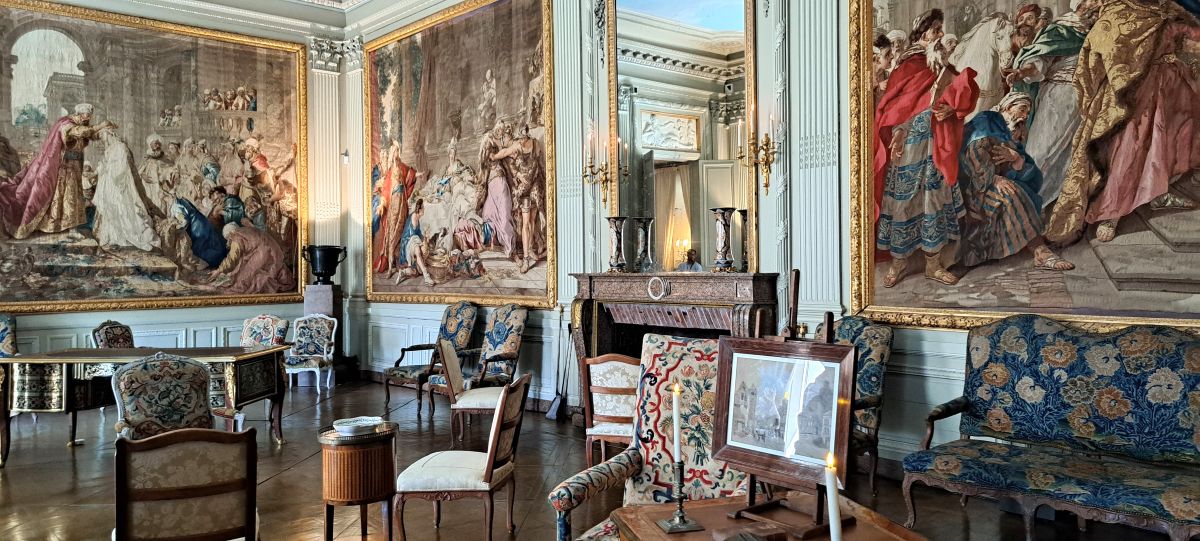
In 2000, funding provided by the department of Val d’Oise and the state secured the purchased at auction of a series of four tapestries from 1769 presenting the Biblical story of Esther that had originally been ordered by the Duchess d’Enville for one of the chateau’s drawing rooms. The four were being auctioned off by the designer Karl Langerfield, who was then parting ways with an 18th-century collection that he’d constituted in part from the La Rochefoucauld sale of 1987. Other objects have returned under similar circumstances. A precious 18th-century inlaid desk that had graced that same room until 1987 was purchase in 2017 by a private citizen who then donated it to the state on the condition that it return to La Roche-Guyon. Others made similar gestures, as gift or loan.
Compare my photo above, taken in June 2026, with the black-and-white photos from the early 20th-century on this page showing the desk and the tapestries, among other furnishings in the grand salon.
Contemporary artists add a breath of fresh air
These small, significant and expensive steps gave a hint of the life and elegance of the chateau as a noble center for enlightened discussion, yet those furnishings were also a reminder of how much more was needed to enliven the place.
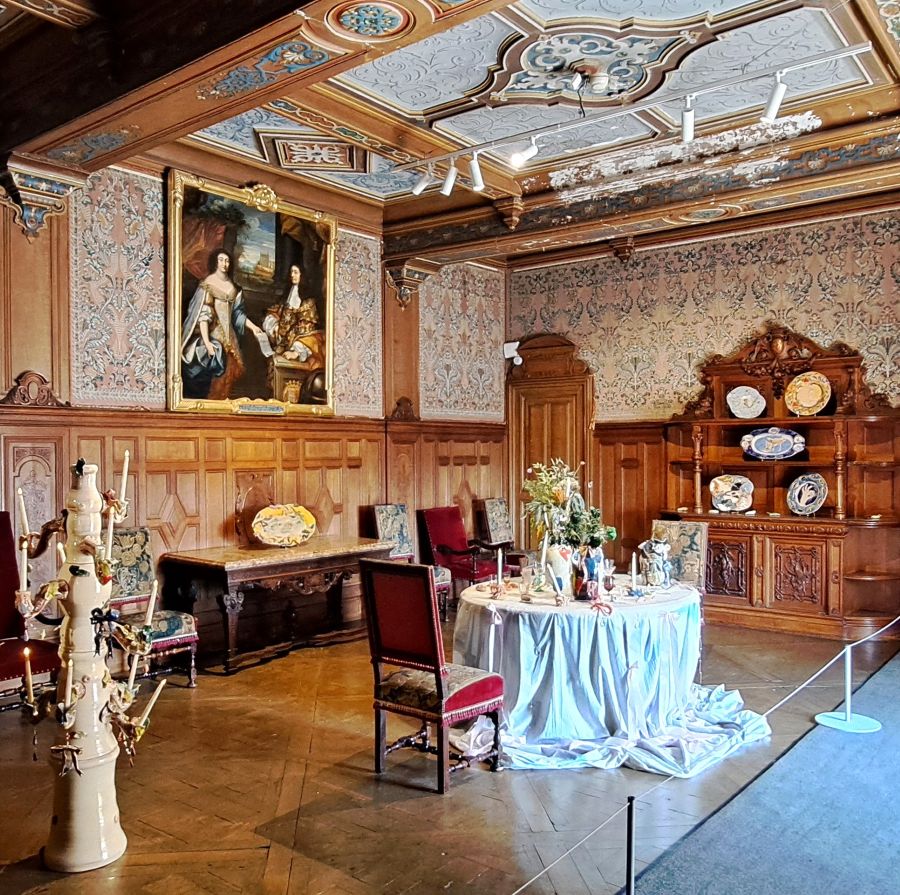
This summer marks a turning point for the chateau as the void now further recedes thanks to the addition of additional precious period furnishings and especially of works created by artists-in-residence. Going forward, a contract recently signed with the Mobilier National, the public entity that stores, maintains and lends out historic furnishings, will bear fruit next year with additional furnishings on display, ensuring that additional spaces within the chateau feel less forlorn.
In an artists-in-residence program now reaching fruition, eight artists or teams of artists were selected to help breathe fresh air into La Roche-Guyon. The program is carried out by artistic and cultural director Emmanual Morin. Three of the artists were tasked with updating visuals, maps, brochures and the chateau gift shop/ticket desk. The others were invited to create works that reveal, enrich and dialogue with the décor, the furnishings, the architecture and the prior use of certain rooms and spaces. The result is a series of accessible and often playful works anchored in specific locations. They lead visitors to linger longer both in appreciation of the works themselves and to consider the ways in which they revive and revisit the spirit of their location.
Here are some of the artists who have taken part in this enrichment campaign.
Castle map and descriptive brochure
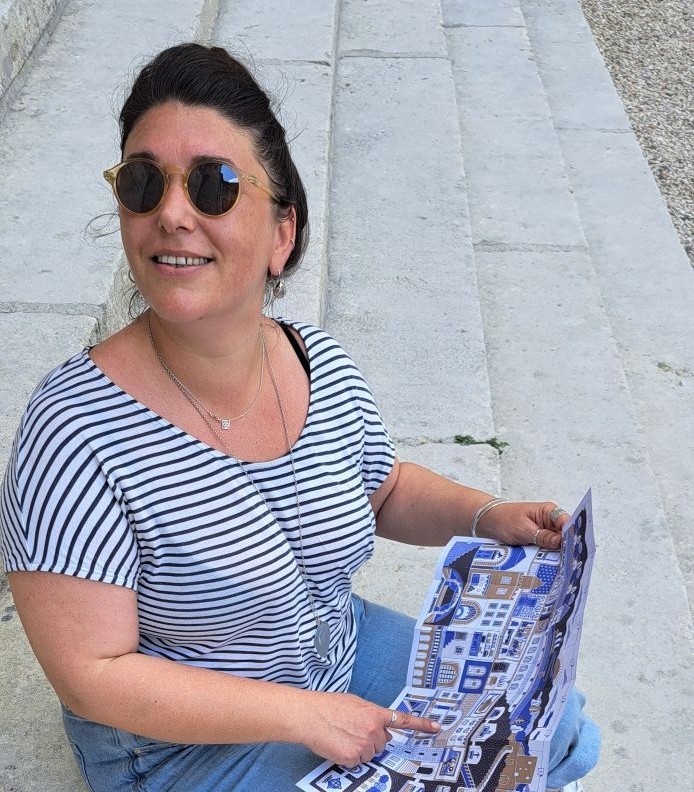
For years, visitors purchasing their entrance ticket were handed a photocopied information sheet intended guide them through the then empty-castle. It was better than nothing, but not truly helpful in understanding the site.
Now, visitors are given an upbeat map of the castle along with an attractive information booklet providing an important primary understanding of the rooms to be visited. These are the work of graphic artist and illustrator Mathilde Arnaud. The map and the booklet, which appeal to children and adults alike, are as much souvenirs as on-site guides.
Entrance and grand staircase
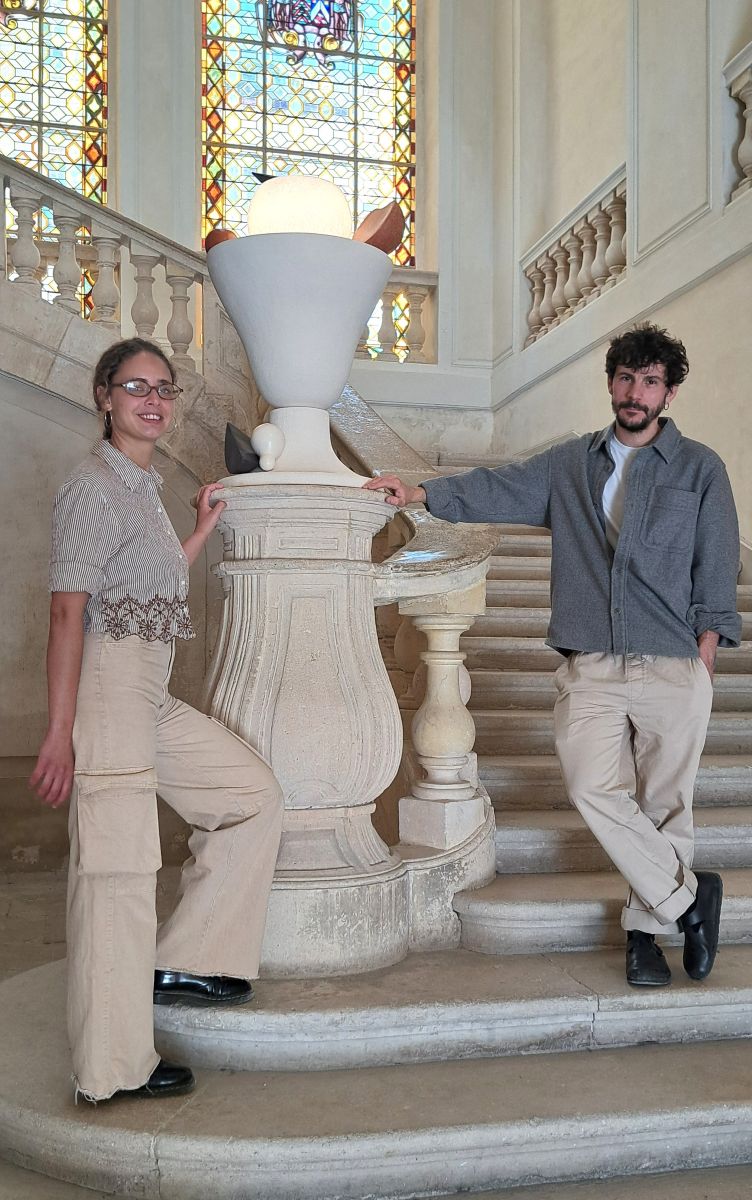
Designers and plastic artists Baptiste Sévin and Jaïna Ennequin, who form Atelier Baptiste & Jaïna, have enriched the entrance and Classical grand staircase with Mineral Cuttings, as they’ve titled their work here, of ceramic and blown glass. The staircase, though lit by windows featuring the arms of La Rochefoucauld family, felt severe and incomplete prior to the introduction of their work. As with all of the artists participating in the current project, their works are not intended to transform their assigned space but rather to dialogue with the architecture and elements in which they’re integrated. Rather than draw attention to themselves, Baptiste & Jaïna’s “cuttings” soften the severity of the space while resonating with the rounded stone of the stairs, walls and banister, the window that lights the landing, and the fruit from the castle’s orchard. Their work will remain in place until 2030.
The dining room and 18th-century drawing rooms
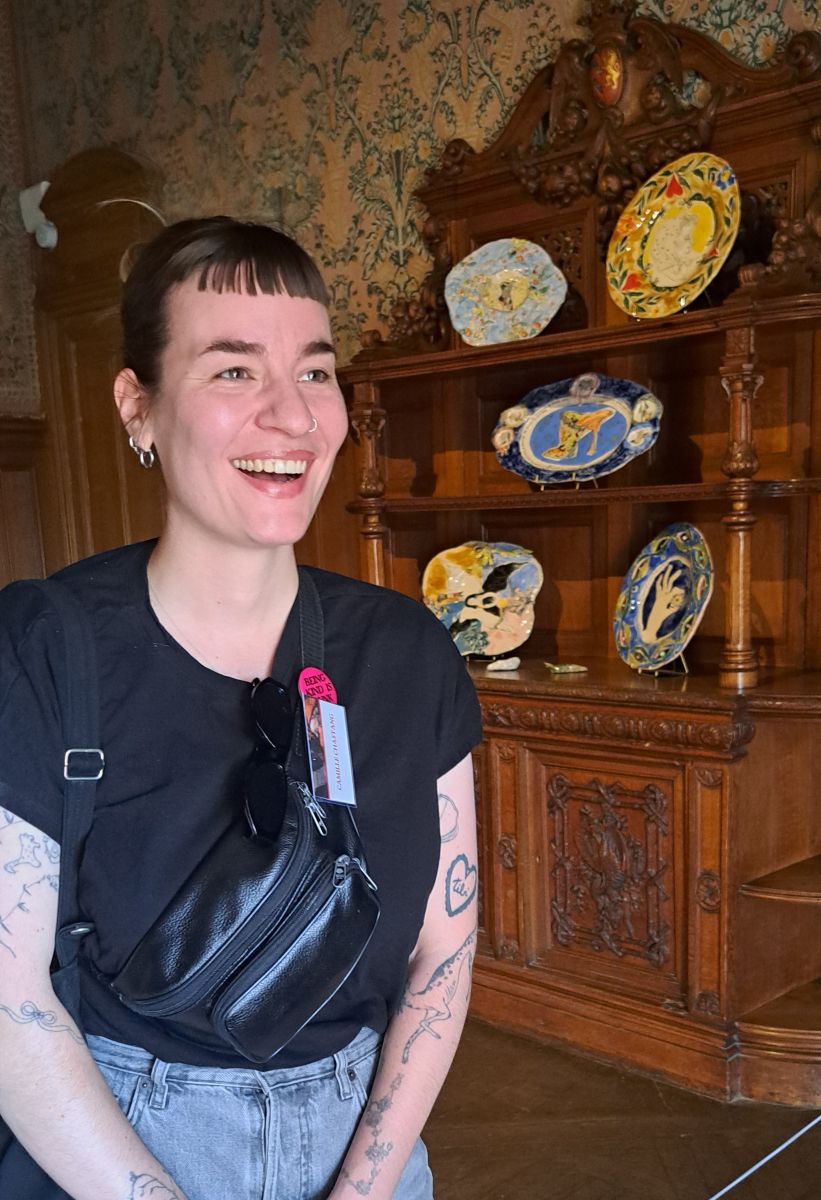
Camille Chastang’s flamboyant, entertaining and floral creations in ceramics and textile present a trail of pleasures in the dining room and the main 18th-century drawing rooms. She has given the title Menus Plaisirs to the collection of objects that she has fashioned. That term refers to the service and budget of an aristocrat, notably a king, dedicated to small or minor (menus) pleasures (plaisirs) such as festivities, entertainment and courtly events. The artist’s Menus Plaisirs will enliven those rooms only until Nov. 1, 2026. For another room, she has designed a floral, watercolor-like wallpaper called Femmage! in honor of the women who have reigned here, in particular the Duchess of Enville. That will remain in place until 2028.
Echoes, a subtle soundtrack
Physical objects—tapestries, paintings, armchairs, tables, desks, and Camille Chastang’s trail of pleasures—help fill the void that once permeated these rooms. Add to that a subtle soundtrack created by sound designers Simon Cacheux and Julia Griner, who collectively form Atelier Blip Bloop.
Their elusive acoustics allow us to overhear the spirit of the succession of 18th-century reception and drawing rooms. It gives voice and breath to the stone architecture, the wood floors, beams and doors, the metal hinges and locks, and the nearby stables and great kitchen garden and orchard. Their soundtrack will play until 2028.
The library, the cabinet of curiosities and the orangery
From that succession of rooms, we enter the large library. Formerly home to a vast and prestigious collection of knowledge, reflections and stories, it now tells of nothing but absence. White faux book covers don’t so much fill the shelves as turn them into wordless ghosts. I would hope that an artist-in-residence will be invited before long to reconsider these shelves. Meanwhile, looking down on visitors from the upper level of the ghostly library, a mysterious creature hints at the curious menagerie in the next room.
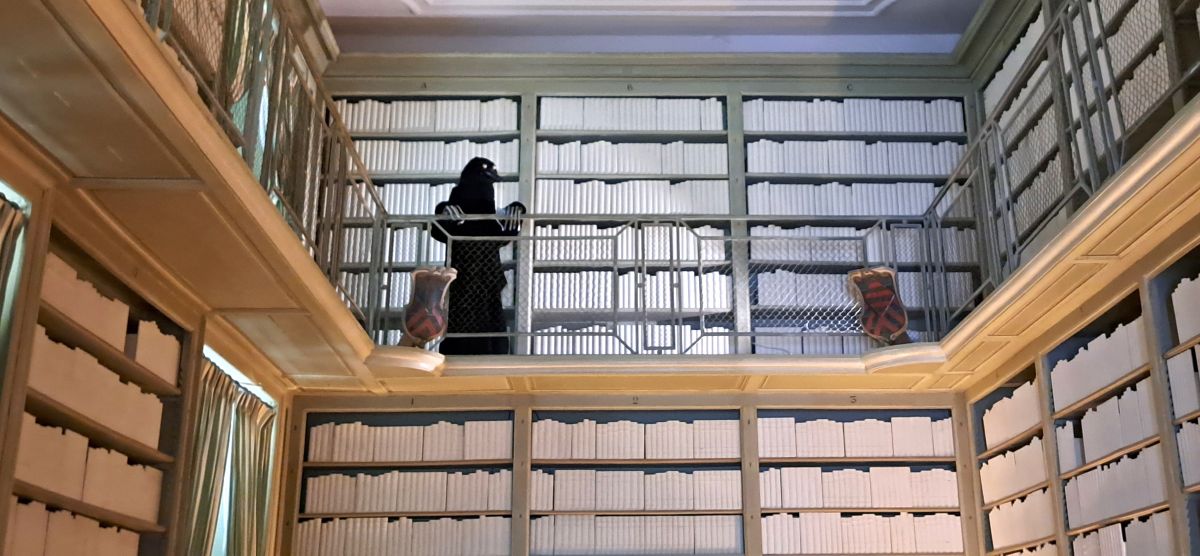
While the library of an aristocratic family reflected a desire for knowledge and understanding as books become increasingly available, a cabinet of curiosities, adjacent here, was a more intimate, more personal space.
Cabinets of curiosities developed in Renaissance Europe as places to store, catalogue, present and examine precious objects of study, from a dinosaur fossil to a taxidermy parrot, and much in between. Numerous aristocrats designated a room for their “curiosities” in the 17th and 18th centuries, and beyond. Here, as in his enlightened library, the curator-aristocrat, whether noble savant or wannabe, could demonstrate to himself and to visitors his curiosity about the widening world as explorers, botanists and archeologist traveled the globe.
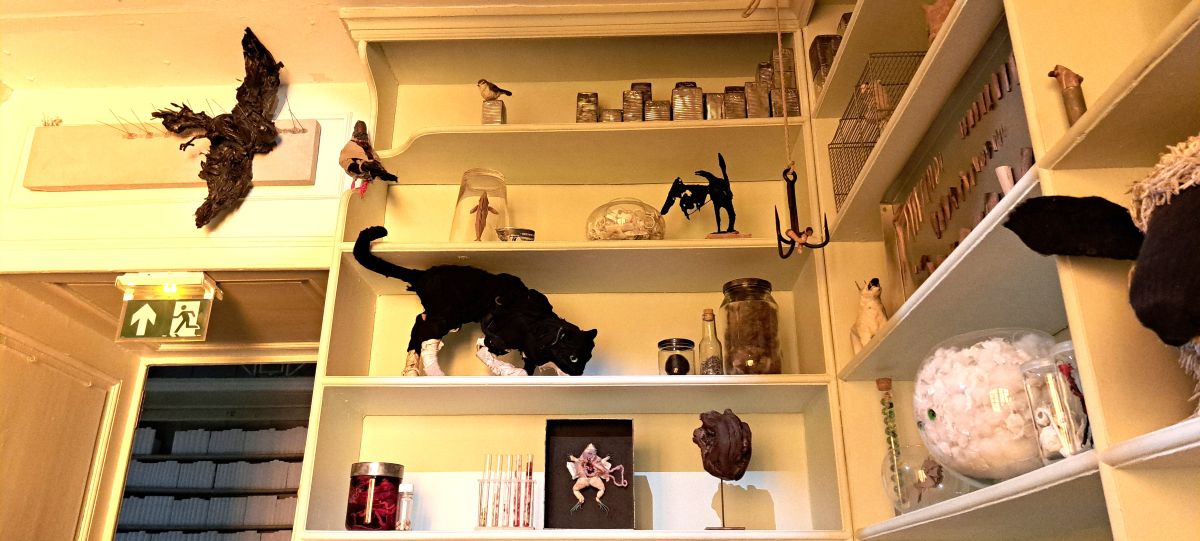
Now, sculptor Yoshikazu Goulven Le Maître has revived that spirit of curiosity with a menagerie of his own creations, titled Mirabilis and curated by Jean-Marc Dimanche.
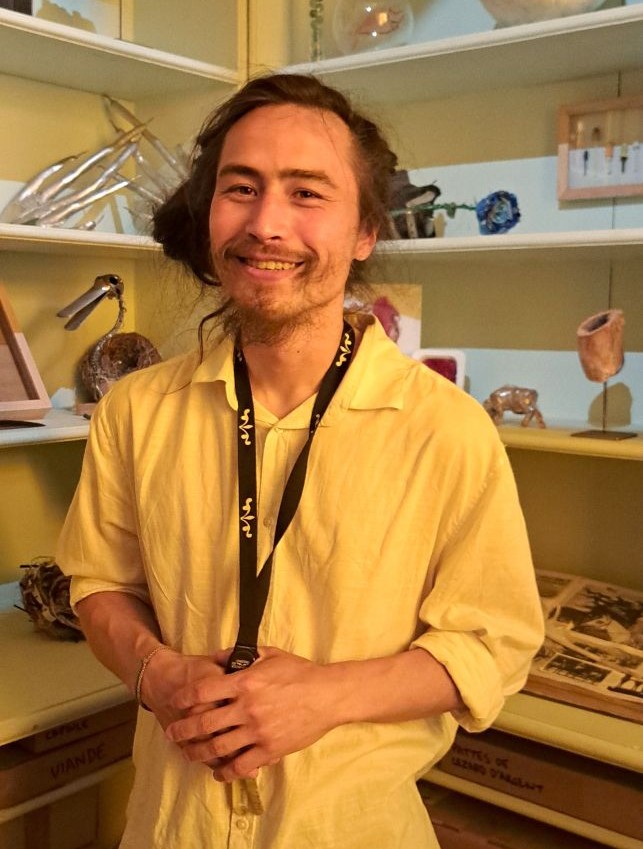
Yoshikazu’s was the longest residency of the artists described here, leading to the most prolific creation. After viewing his works, visiting artists, crafters, scrappers and tinkerers of every age will want to pick up string, metal, fabric, buttons and minutia of any kind to start creating when they get home. Mirabilis will remain in place until 2028.
In addition to that wondrous menagerie, the artist has created larger works that can be seen in the former dog yard, situated shortly beyond the cabinet of curiosities, and a monumental bestiary in the dimly lit former orangery or greenhouse dug into the cliff, seen at the end of a visit. That bestiary, titled Fauna Fabulosa, will remain in place only until Nov. 1, 2026.
The theater
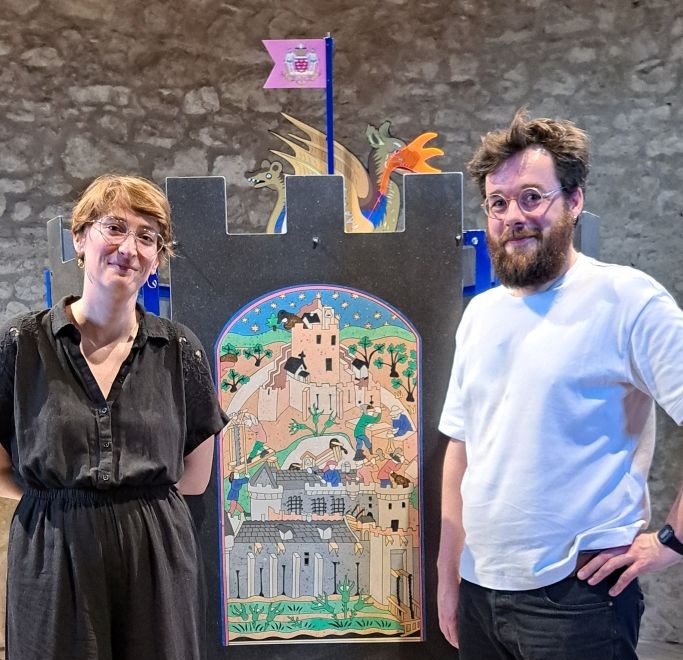
The Duchess of Enville created a precious little theater at La Roche-Guyon that is need of much restoration before being open to the public anytime. Photos of that space can be seen after the cabinet of curiosities.
As a reminder of its existence, Héllène Gaulier and Gwenolé Gasiner, of Agence GG, have designed theatrical games using pre-Industrial mechanics. One is shown by the theater and the other is shown within the medieval keep atop the cliff. Their works will remain here until 2030.
The truncated castle tower
Eventually, following an athletic climb, visitors are rewarded by the view that leads off this article, over the Seine Valley from the top of the tower of a castle keep. The tower, dating from about 1190, was at least one third taller before being beheaded, so to speak, in 1793, during the French Revolution. It was truncated to cut the notion of nobility down to size (hereditary nobility was first abolished in 1790) and to prevent such a prominent position from falling into the hand of counter-Revolutionaries. This had been a strategic location for nearly 900 years by then.
In 911, the Treaty of Epte set the border of a territory to be controlled by the Norsemen who’d conquered the territory and their descendants—the territory of Normandy. The Epte River, which flows into the Seine, runs about half a mile from here as the crow flies. On and off for centuries, that was the border between Normandy and France proper. It still represents the border between Normandy and Ile-de-France, as the Paris region is officially called. (Giverny is on the opposite side of the border.)
See this France Revisited video of the view.
Rommel at La Roche-Guyon
The Château de La Roche-Guyon’s strategic location at the border between Normandy and the Paris region explains why it served as German Marshall Edwin Rommel’s headquarters after his appointment by Hitler to oversee a large swath of the Atlantic Wall during the Second World War. The territory that he oversaw included the section of Normandy that would become the D-Day Landing Beaches.
During the Occupation, the Germans built casemates into the limestone cliff so as to protect their artillery as much as possible from Allied aerial bombing. Meanwhile, resistance activities took place in the village itself. An audiovisual installation called The Voice of the Casemates, 1944, by the French-Polish artist Tomasz Namerla will remain within the gloom of cliffside casemates until 2030.
For its WWI history alone, I’ve often suggested that those driving to the Normandy Landing Zone from Paris for several days stop here for a visit, just a 15-minute detour off the highway. Also, it makes for a nice break in the drive. Thanks to the recent cultural and art program, La Roche-Guyon now makes for an even richer break.
Visiting La Roche-Guyon with respect to Giverny
All told, the Chateau de La Roche-Guyon deserves a place on the traveler’s radar, perhaps not (yet) as a significant detour, but at the very least a stop for an hour or two or three for those driving to/from Normandy, or those planning on visiting Giverny, or those interested in also visiting the nearby natural and preserved zone called the Vexin Français.
Château de La Roche-Guyon is open daily 10am to 18am from April 1 to November 1, which more or less coincides with the opening season of Monet’s House and Gardens at Giverny. Additionally, and for the first time, the chateau will open from Dec. 5, 2026 to Jan. 4, 2027, with seasonal decorations and the creation by children’s book author Elisa Martin of a graphic novel whose action takes place at the Château de La Roche-Guyon.
Many touring companies based in Paris propose a Giverny + Versailles day trip from April 1 to Nov. 1. A Giverny + La Roche-Guyon combo, though less blockbuster, is a more natural and unhurried combo.
DIYers without a car can reach Giverny by taking the train to Vernon from Paris’s Saint Lazare Station then a shuttle or taxi or bike from Vernon. With no offense to Giverny, that’s a lot of travel and timing for relatively low touring ROI, unless you’re a hardcore Monet fan. An interesting cycling day could be made by taking the train to Vernon from Paris, renting a manual or e-bike near the Vernon train station, then visiting Giverny and La Roche-Guyon before cycling back to Vernon. That’s about 20 miles in all, mostly on narrow roads rather than designated cycling paths. (I haven’t yet done that and would like to hear from anyone who has.)
There’s a full-men restaurant by the river in the village of La Roche-Guyon, but keep it simpler, I say, by opting for lunch or a snack at the bakery near the foot of the castle or at the friendly café-bistro next to that. If La Roche-Guyon maintains its upward trajectory en route to becoming a destination, other worthy options will undoubtedly open.
© 2026 by Gary Lee Kraut