

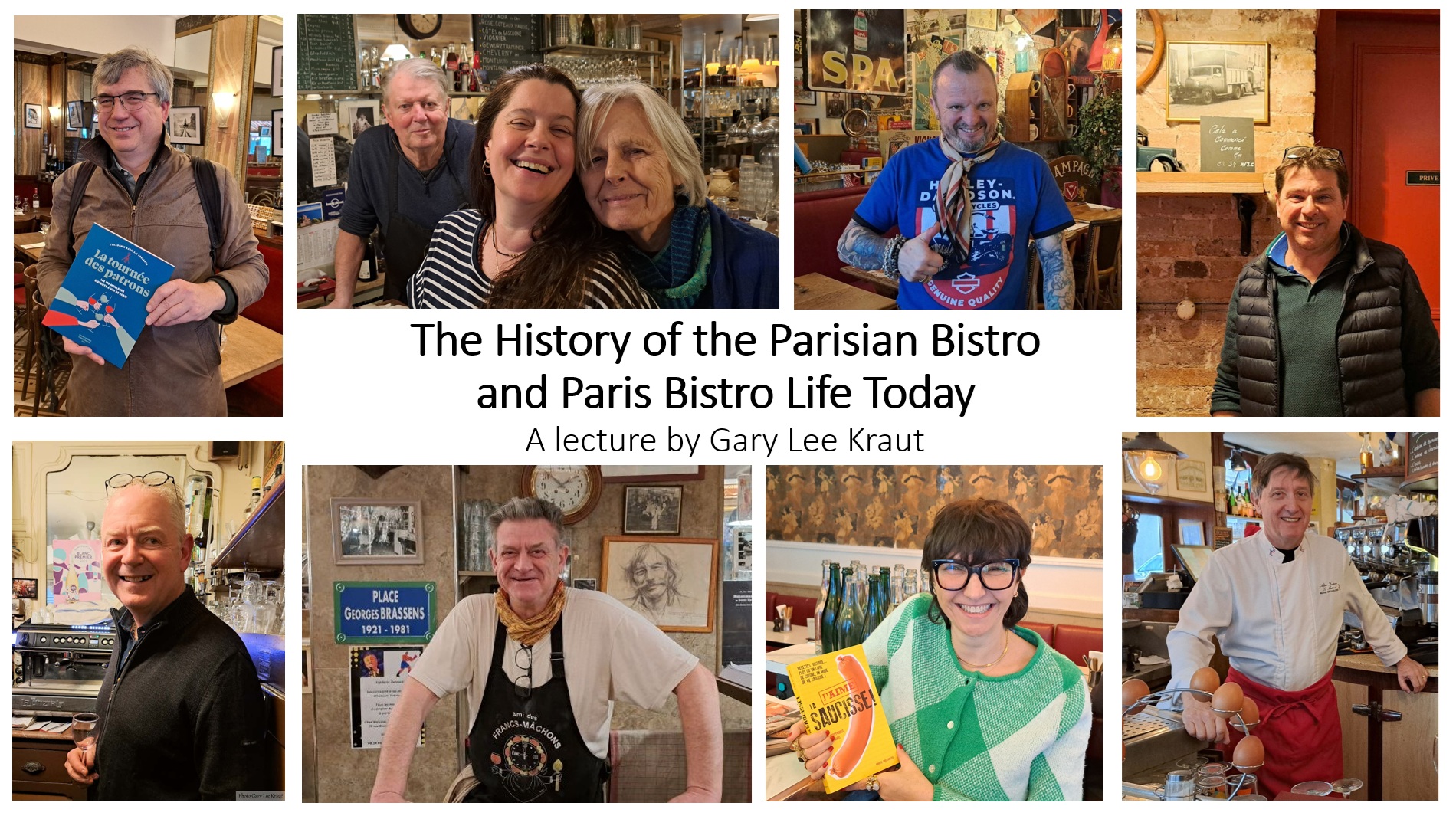
A video presentation examining the history of the Parisian bistro, describing eight exemplary bistros and their keepers, and telling about defenders and promoters of Parisian bistro culture, for those would like to take the plunge into Paris bistro life today.
The term bistro—or bistrot, as it is more commonly written in French—has evolved over the past 150 years. And it’s meaning in French is not identical to its meaning in English. For that reason, when English-speaking visitors to Paris ask me (or their concierge or their phone) to recommend “a good neighborhood bistro,” what they’re looking for does not necessarily correspond to what Parisians think of as “a good neighborhood bistro.”
That’s because English-speaking travelers are typically looking for a restaurant serving fresh traditional French cuisine—period. Nothing wrong with that. However, the Parisian bistro can also be more than just a restaurant.
For bistro purists with a sense of bistro history, the bistro is better defined as an unpretentious neighborhood gathering place with an active bar counter and serving fresh traditional cuisine that’s relatively inexpensive for the neighborhood, along with inexpensive wines (even if more expensive wines may also be available), a place that remains open beyond meal hours, with an ever-watchful owner or manager on the premises.
To call such a place a “neighborhood bistro” would be redundant since a bistro in that more-than-a-restaurant sense necessarily implies that neighbors and regulars stop by through the day for coffee, a drink, to escape the heat or the cold, or simply to say hello, and to enjoy a nice, inexpensive meal if they like. Such a bistro—a more-than-a-restaurant bistro—is defined not by food alone, however enjoyable its bistro cuisine may be, but by its role as a vector of sociability and an example of art-de-vivre à la française.
Paris Bistro Life, the Lecture
Over the past two years I’ve been giving a lecture on that very subject, in which I examine the history of the Parisian bistro and speak about an array of more-than-a-restaurant bistros. Titled The History of the Parisian Bistro and Paris Bistro Life Today, I recently made this presentation to the Federation of Alliances Françaises USA, via Zoom, a recording of which you can watch below.
In the lecture, after considering the origins of the word bistro/bistrot, I present an exemplary selection of eight more-than-a-restaurant bistros that I recommend for those wishing to take part in Paris bistro life. They’re located in various neighborhoods in Paris—and that I recommend for those wishing to take part in Paris bistro life—include Christophe Hanz’s Le Vaudésir, 41 Rue Dareau, 14th arr.; Jean-Louis Bras’s Au Bon Coin, 49 Rue Des Cloys, 18th arr.; Fanny and Bruno Louvrier’s Au Bougnat – Chantier de Notre-Dame, 26th rue Chanoinesse, 4th arr.; Claude and Henrika Derrien’s Le Verre à Pied, 118 B rue Mouffetard, 5th arr.; Robyn Greiner’s L’Ami Pierre, 5 rue de la Main d’Or, 11th arr.; Chez Walzak – Aux Sportifs Réunis with Chef Boby, 75 rue Brancion, 15th arr.; Nicolas Gounse’s Le Guersant, 30 Bd Gouvion Saint-Cyr and Eric Mauboussin’s Le P’tit Zinc, 2 rue des Plantes, 14th arr.
I also speak in this presentation about various organizations and individuals that defend and promote traditional bistros and cafés as essential vectors of sociability and art-de-vivre à la française, spearheaded by Alain Fontaine, owner-chef of Le Mesturet.
Have a watch, whether for the full presentation or simply to hear about some of the specific bistros and bistro-keepers mentioned above.
Welcome to Paris Bistro Life.
© 2026, Gary Lee Kraut