

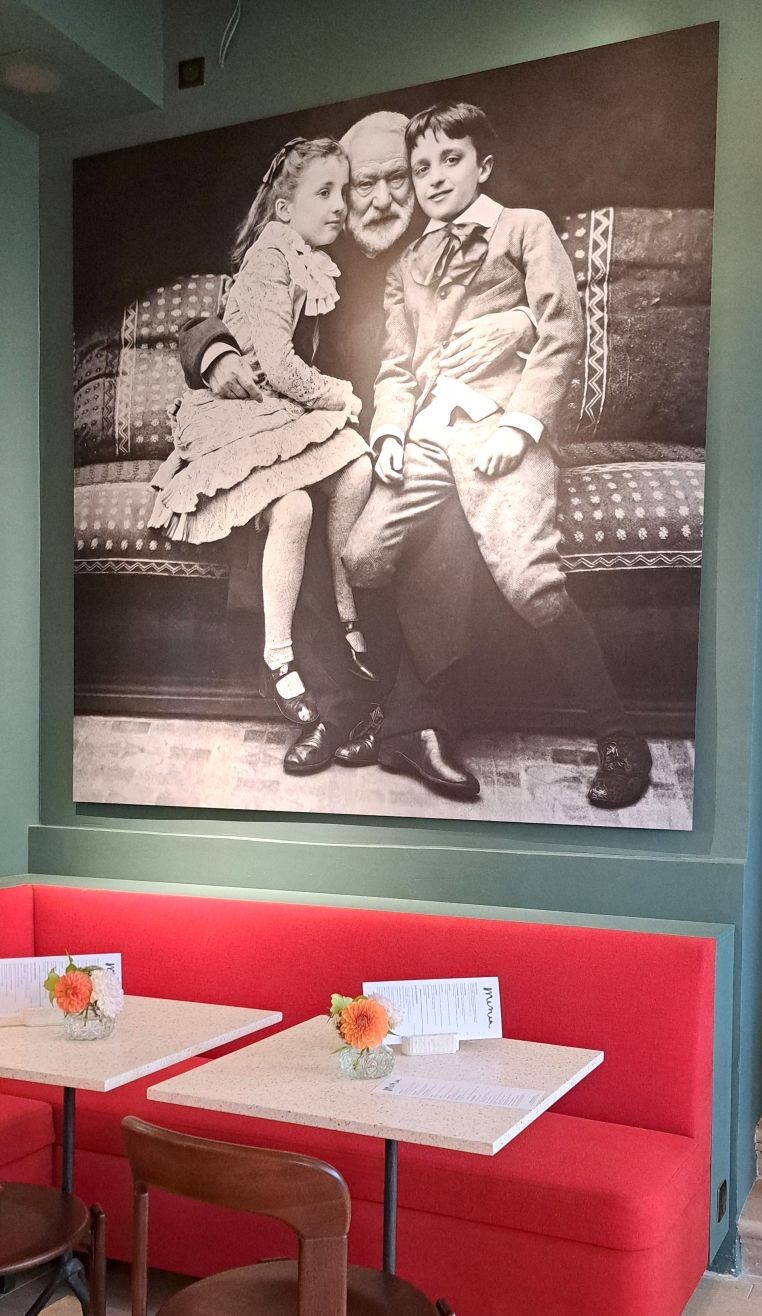
A lovely new café has just opened in what is among the loveliest of lovely courtyards in the Marais. It’s just off the Place des Vosges, behind the building where Victor Hugo lived from 1832 to 1848. I’m writing this article by the little fountain in the courtyard café. Ideally that’s where you’ll read it. A lovely place, I say in all sincerity. The café is named Papapa, which is what Hugo’s beloved grandchildren called him. An endearing blown-up photograph of them decorates the interior.
That photo was taken long after Hugo lived here. He was just 30 years old when he moved to the vast apartment upstairs, a workaholic with a wife and four small children, already a literary luminary of the Romantic age, an established poet, playwright, essayist and novelist.
What could be more exemplary of that Romantic era in France and of Hugo’s brilliance as a storyteller than the bestselling novel that he published a year before the move: Notre-Dame de Paris. The French title immediately signaled that the main character in this page-turner would be the battered cathedral in the historic heart of the capital. But the English publisher didn’t think that Gothic enough for a foreign audience, so it made poor, maligned Quasimodo the titular protagonist: The Hunchback of Notre-Dame.
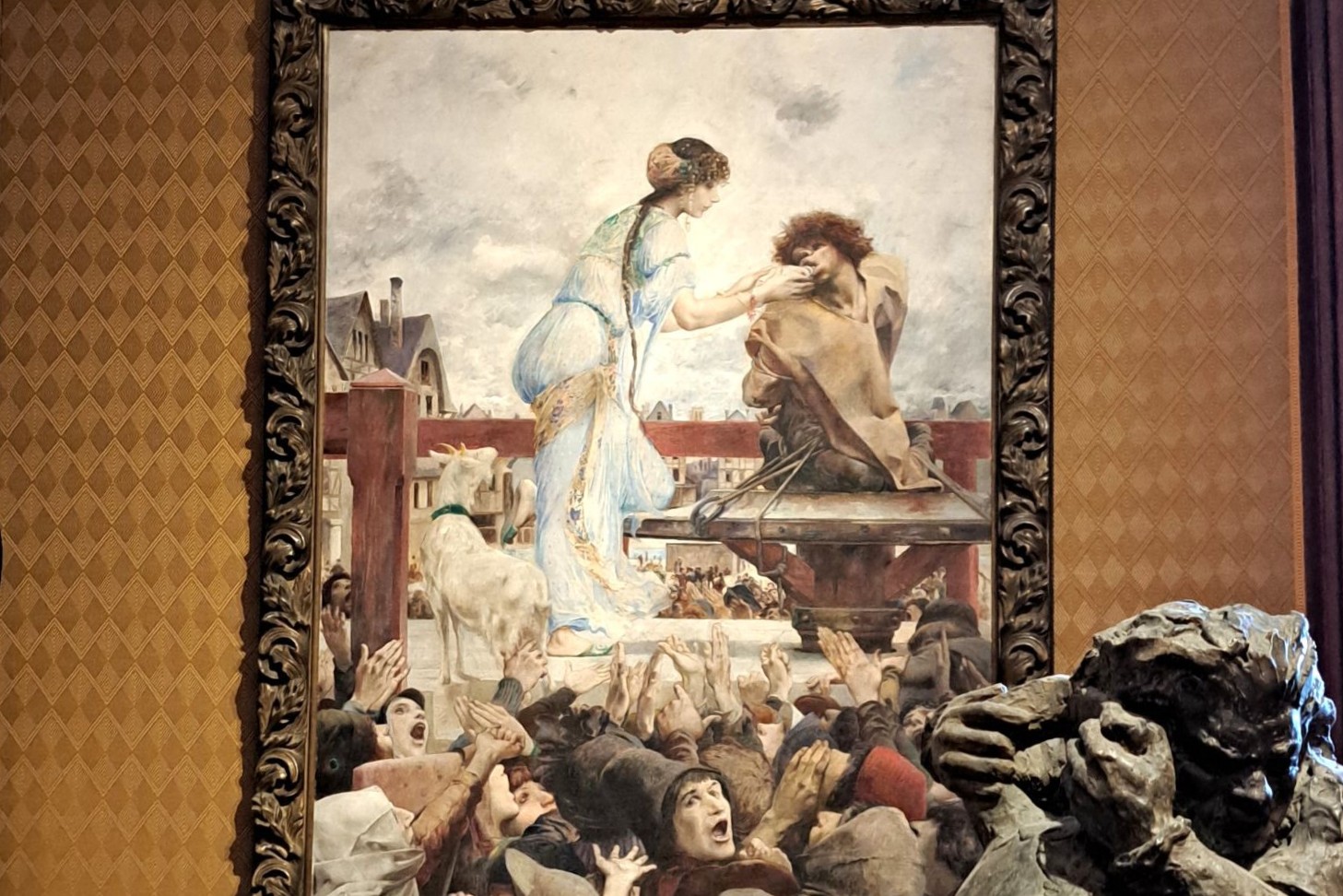
Who can forget that high-drama scene-for-the-ages in which the beautiful, seductive Esmeralda finds the heart and the courage to give the thirsty, pilloried hunchbacked bellringer a drink of water, as Notre-Dame Cathedral looms in the background!
Certainly not I as I sit by the fountain in the courtyard café sipping a flat white. Yes, they’ve got flat white on the menu. Café au lait be damned! Flat white—now there’s a bestselling term in the literature of new cafés in Paris. Still, Paris it is. A lovely courtyard in the Marais. Dress the lovely parisiennes at the next table in bangles, scarve and flowing diaphanous skirts and any of them could play Esmeralda. Cue the goat.
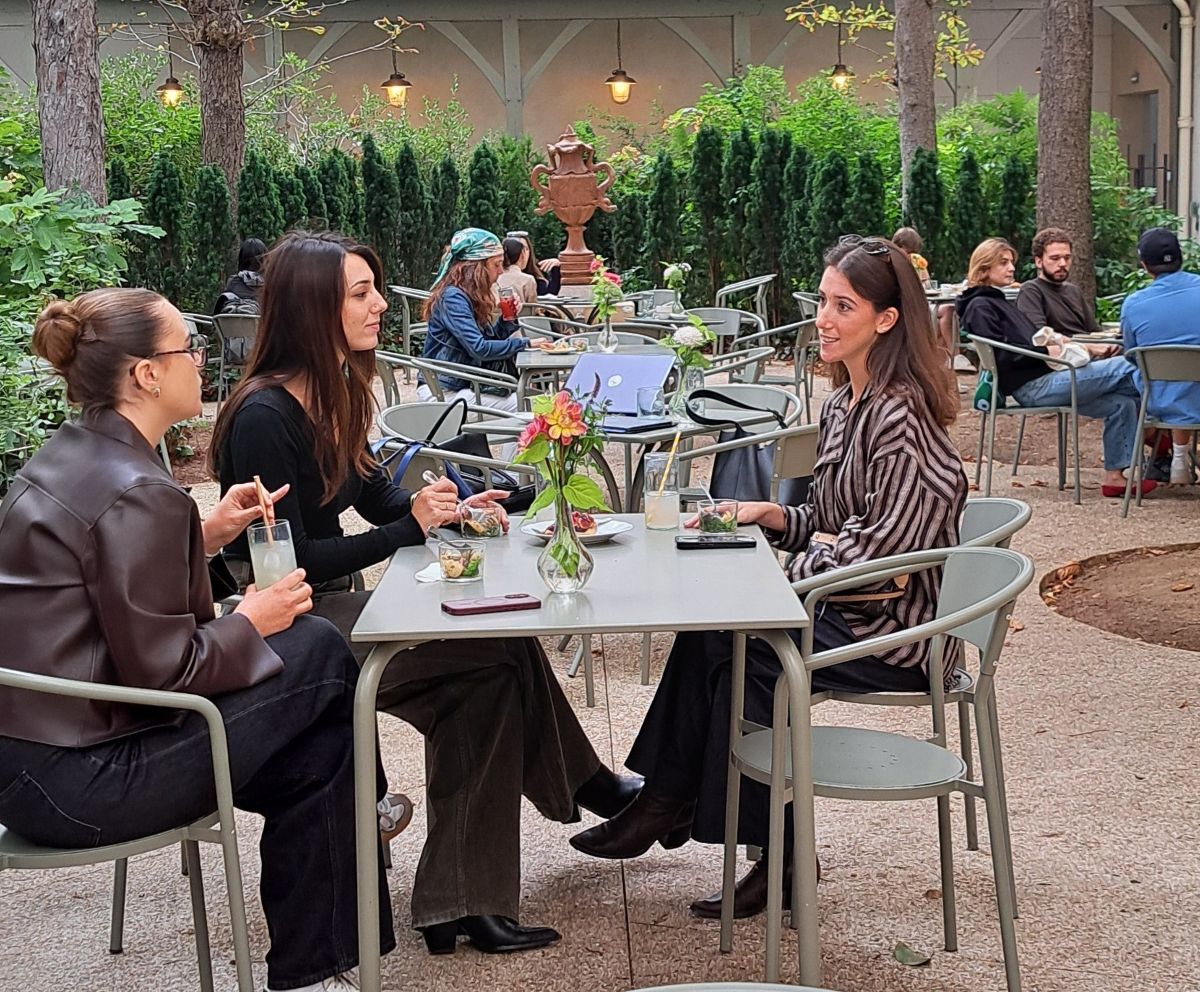
Such a beautiful morning to experience Papapa. Seriously. Not the best place to contemplate medieval misery today, but maybe I’ll go upstairs to visit the Hugo’s apartment once I’ve finished my flat white, to imagine him looking down into the courtyard. Maybe to watch a mistress walk by. Or maybe, just maybe, in literary mode, to look down to this very fountain as he undertook a new project: exploring the more contemporary misery and revolt to which he was personally witness. That was toward the end of his stay, though the 5-volume work wouldn’t reach shelves until 1862: Les Misérables, a title that immediately draws attention to the miserable and the wretched of the world. Might as well just call it that in English.
Hugo explored numerous subjects in his work, often with great emotion, drama and sentimentality, yet his reputation soared as a republican activist, sympathetic to the downtrodden, un écrivain engagé, as we say in French, a socially committed writer. Unlike the present one. For how can I—how can anyone—do anything but ♥ Paris in this lovely courtyard café. Papapa is a much mellower name for a café serving a flat white in the Marais than Les Misérables, don’t you think? (There’s already café named Le Quasimodo Notre-Dame by the cathedral.)
Here, on this beautiful September morning, all seems right in the world. Every glance, every exchange, every sip, every bite (it’s the press opening and I’m trying everything on the menu) reminds me that I ♥ Paris, where City Hall’s fights for social justice by promoting the freedom for cyclists and scootists (pedestrians be damned!) and takes seriously its management of heritage sites by thoughtfully doling out concessions for cafés in the courtyards of city-operated museums. Call it a flat white social conscience.
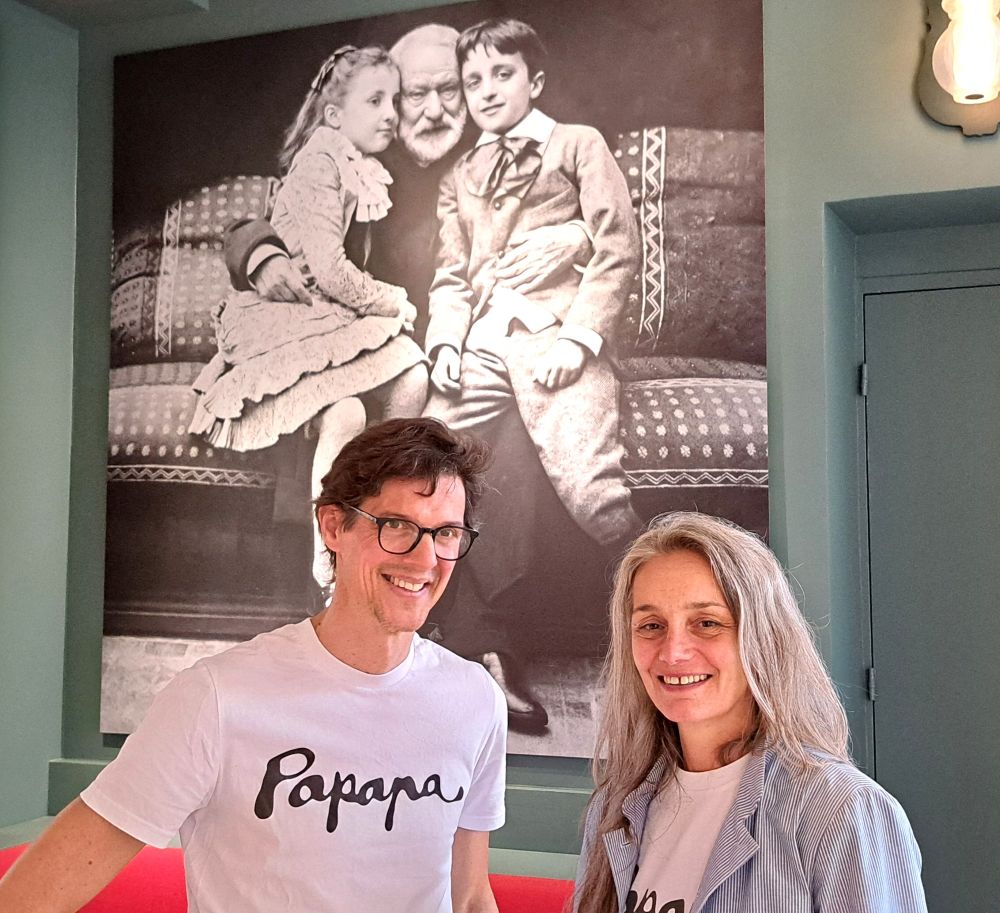
Hence the 6-year concession for this café to Les Editions Délicieuses, a company operated by Damien and Caroline Nobile. Lovely people with good business acumen. I chatted with Damien. He used to work in finance, Caroline in fashion, in New York, before returning to Paris twenty years ago and transitioning into the event-catering and, more recently, courtyard café business.
Damien and Caroline aren’t only good at operating cafés serving pleasing fare and flat whites, they’re also good at naming their establishments. They started out with Fika, the sweet little café at the Swedish Institute in another Marais courtyard. Fika is a Swedish term for a coffee break. Now there’s Papapa. This fall they’ll take over the greenhouse café and tea room at the Musée de la Vie Romantique in the 9th arrondissement, the house-museum that speaks of music, life and literature during the Romantic area. It will be called Cornelia, the name of both the mother and daughter of the house’s first occupant. Then next spring they’ll take over the café concession at Balzac’s House in the 16th arrondissement, rebranding it Honoré. That was Balzac’s first name. Endearing names for endearing places. Altogether, they offer literary travelers pleasing fikas. Or think of it as a wonderful opportunity to learn about 19th-century literature, music and art during your flat white tour of Paris. Café au lait be damned!
Place des Vosges / Place Royale
Sorry, I got distracted by my conversation with Damien. Where was I? Oh yes, the Place des Vosges. Can you think of an adjective to describe it?
Technically, Hugo didn’t live on the Place des Vosges. He lived on the Place Royale. That was the square’s name before the Revolution of 1789. In 1800, after the blood had dried and Napoleon became top dog, it was renamed the Place des Vosges to honor the department or subregion in eastern France for being an early adopter of the Revolution. But once a king returned to the throne after the fall of Emperor Napoleon, the square again became the Place Royale (Hugo lived here in the time of King Louis-Philippe), then eventually Place des Vosges again with the affirmation of France’s Third Republic.
Though royal during Hugo’s residence, the neighborhood’s aristocratic glory days were long gone by the time he arrived. By then, the former noble mansion of the early 17th century where he lived, one of 36 such mansions on the square, had been divided into fourteen rental apartments. The Marais was no longer so fashionable, and its decline would continue for another 130 years. Nevertheless, the square remained a rather decent place to live in the 1830s and 1840s, when Hugo’s celebrity and engagement were on the rise. And always that (add your adjective) view.
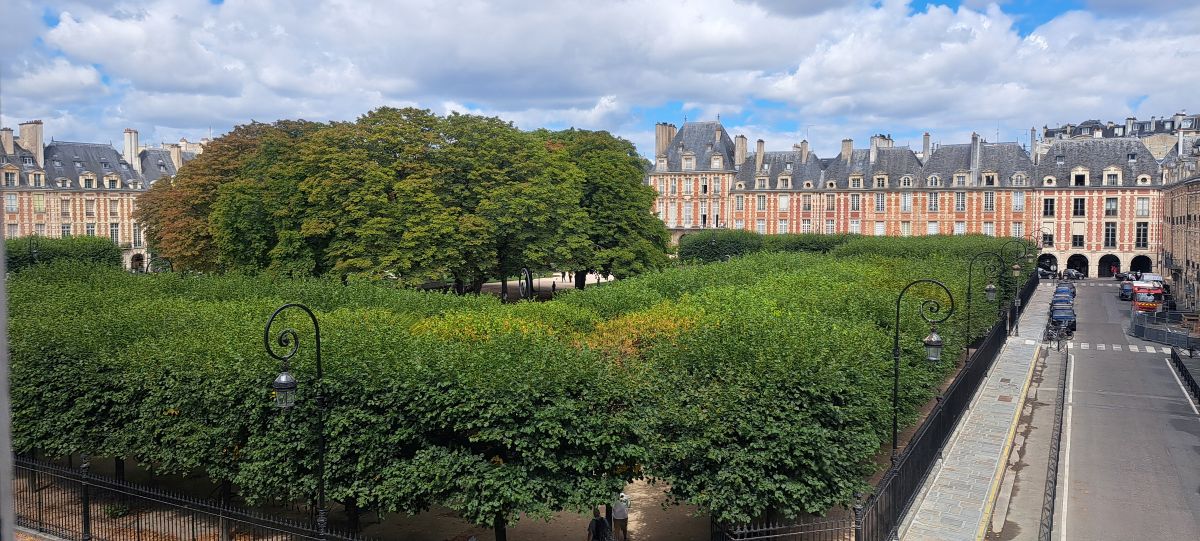
Whether Victor Hugo thought of this as the Place Royale or followed his republican conscience in thinking of it as the Place des Vosges, I don’t know. Honestly, I don’t know that much about the man. But from what I’ve read—Wikipedia, Notre-Dame de Paris, Les Misérables, and his poem Demain, dès l’aube (Tomorrow, at dawn) about living with the grief of the death by drowning of his 19-year-old daughter Léopoldine—from what I’ve read, he had an extraordinary life, imagination and strength of character, to which you can add love life if you’d care to look further into that.
Maison Victor Hugo, the Museum
His large apartment on the third floor (2e étage) of what become a city-owned building opened as a museum dedicated to him in 1903. I haven’t been there in a while so I might just take a peek after I’ve finished the flat white and this article. As I recall, the apartment is not as he lived in it for 16 years. Instead, the Maison Victor Hugo, as it’s called, presents a mix of artwork by and about the writer and his works, along with wallpaper, curtains and furnishings that evoke or come from other places and other periods in his long life.
One of those places was the Anglo-Norman or Channel Island of Guernsey, where he, a literary warrior for democracy and social justice, lived in exile from France’s Second Empire from 1855 to 1870. Doesn’t quite have the same ring as becoming a Florida resident to escape taxes in New York and New Jersey, but to each his Guernsey. That era is represented here by the drawing room of Chinese inspiration and the dining room of medieval inspiration, both of which he created for his mistress’s house at Guernsey. Naturally, she joined him in exile. Apparently, one can have a social conscience, enjoy one’s comforts and be a talented decorator. Maybe even play pickleball for all I now.
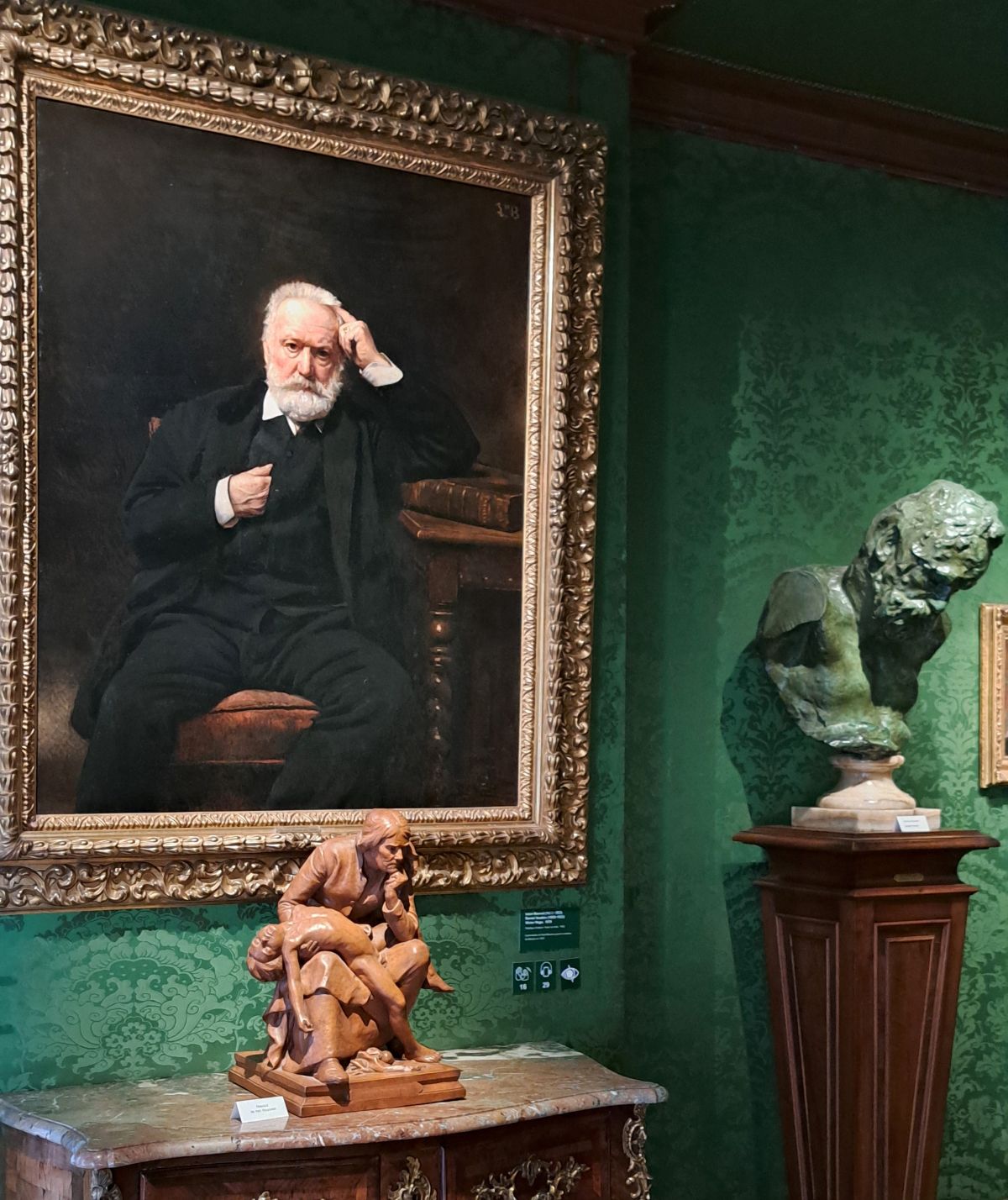
The museum’s final room presents a reconstitution, more or less, of his bedroom in the 16th arrondissement where he died at the age of 83 in 1885. Remember that scene from Les Misérables when Cosette reaches Jean Valjean at his deathbed and he manages to breath “Dying is nothing; it’s terrible not to live,” proof that social and political engagement requires a heavy dose of melodrama? Among Hugo’s own last words were these, written three days before he took his last breath: Aimer, c’est agir, To love is to act. When I try to contemplate what that might mean while sitting alone with a flat white in this lovely setting of the café courtyard, all that comes to mind is that it sounds like the name of a cocktail, to be listed alongside Sex on the Beach, Salty Dog and Penicillin. Perhaps I’m being cynical because I now recall learning somehow that one week after Hugo’s death, a tremendous funeral procession attended by perhaps two million people led his remains to the Pantheon. They weren’t just there to mourn a writer but a man who had become an activist for social justice and the values of a secular republic. That is what we should all contemplate at Papapa.
Just kidding! How can anyone think of social justice while ♥ing Paris with a flat white? Honestly, has anyone ever sat down with a flat white in Paris with a social conscience that goes beyond “I deserve this” or “Wait, let me take a picture first”? Come to think of it, flat white may itself be a form of international social conscience, especially when everyone, irrespective of race, color, creed or other variances, gets a ♥ or a🌿on top. Café au lait be damned!
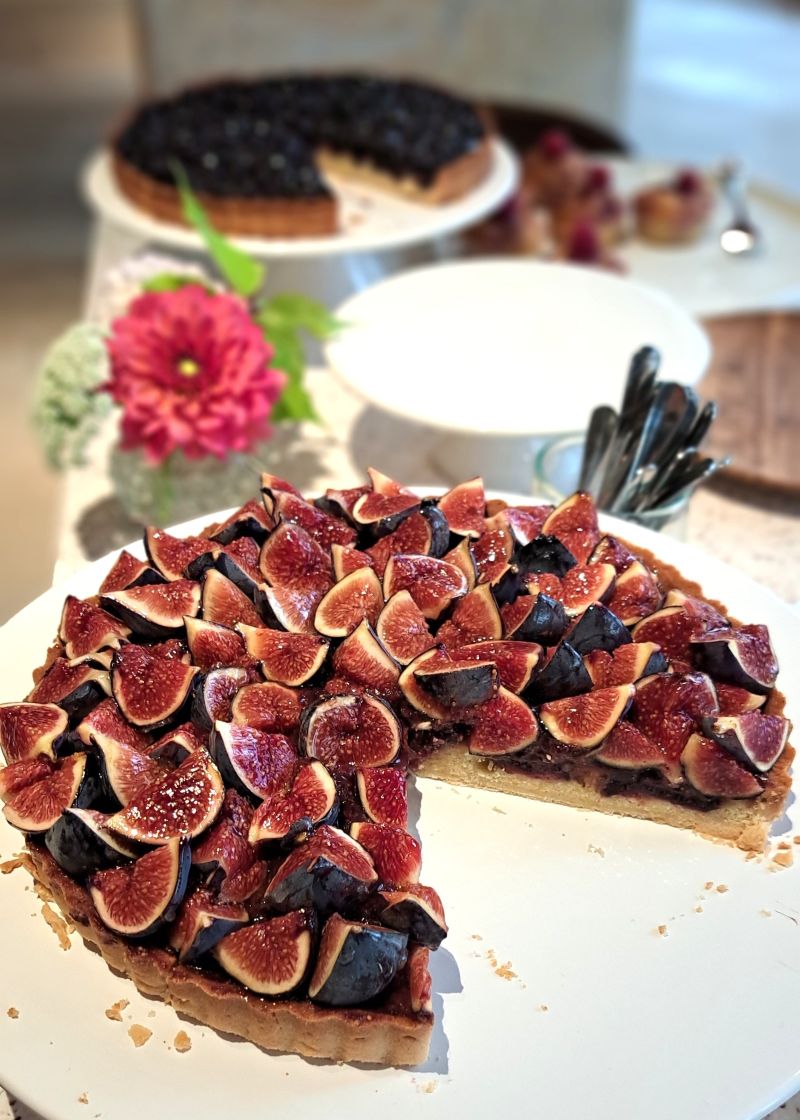
In addition to his 15 years of exile on the Anglo-Norman island of Guernsey, off the coast of Normandy, Hugo had other visits and residences in the region, not to mention that Léopoldine drowned in the Seine in Normandy. Hugo’s Normandy connections drew Damien and Caroline Nobiles to honor that region in creating their menu for a light lunch, a savory snack and pleasing pastries, cookies and biscuits. On the savory side, baked camembert, a Guernsey bean jar, crab-and-apple on buttered brioche and, on weekends, oysters from the Chausey Islands. On the sweet side, pear douillon, mirliton, a caramel-topped cookie and a seasonal fig tart. Butter is branded Isigny Sainte-Mère. Then there’s the wink-wink of the flat white on the coffee menu, reminding us that none of this actually has anything to do with Victor Hugo. All to be enjoyed within gurgling distance of the charming little fountain or inside by the looming photo of Papapa himself.
You can enjoy the lovely flat whiteness of the café without entering the museum. Just say “Bonjour” to the guard as you pass under the arcade into the courtyard. But maybe your conscience will bother you if you’ve come this far without at least going up for the view. As encouragement, entrance to the Victor Hugo House is normally free. As discouragement, there’s currently an admission fee of 11€ (9€ for students 18-26, free for under 18) until Nov. 22, though that gives access to both the permanent collection on the third floor and the temporary exhibition “Hugo and Architecture” on the second—yes, another interest of the great man.
On its own, a Guernsey bean jar doesn’t help me understand what made Hugo a fabulous storyteller, a multi-talented creator, a social committed writer and a hero in the fight for freedom and democracy. So I’ve decided that the time has now come to leave this loveliest of lovely courtyards to go upstairs to contemplate the fellow and ponder what it means to have a social conscience, even if only out of flat white guilt.
© 2026, Gary Lee Kraut
Loved this Gary. It’s been ages since I’ve visited Victor Hugo’s flat. I have a very clear memory of his standing writers desk (did I make that up?) guess it’s time to return and find out.
Meanwhile, that is a beautiful fig tart… and beans in a jar puzzles me. 😏
Thanks, Marie. Hugo’s high desk is still there. It’s in same room as the portrait and bust shown in the article. Gary