

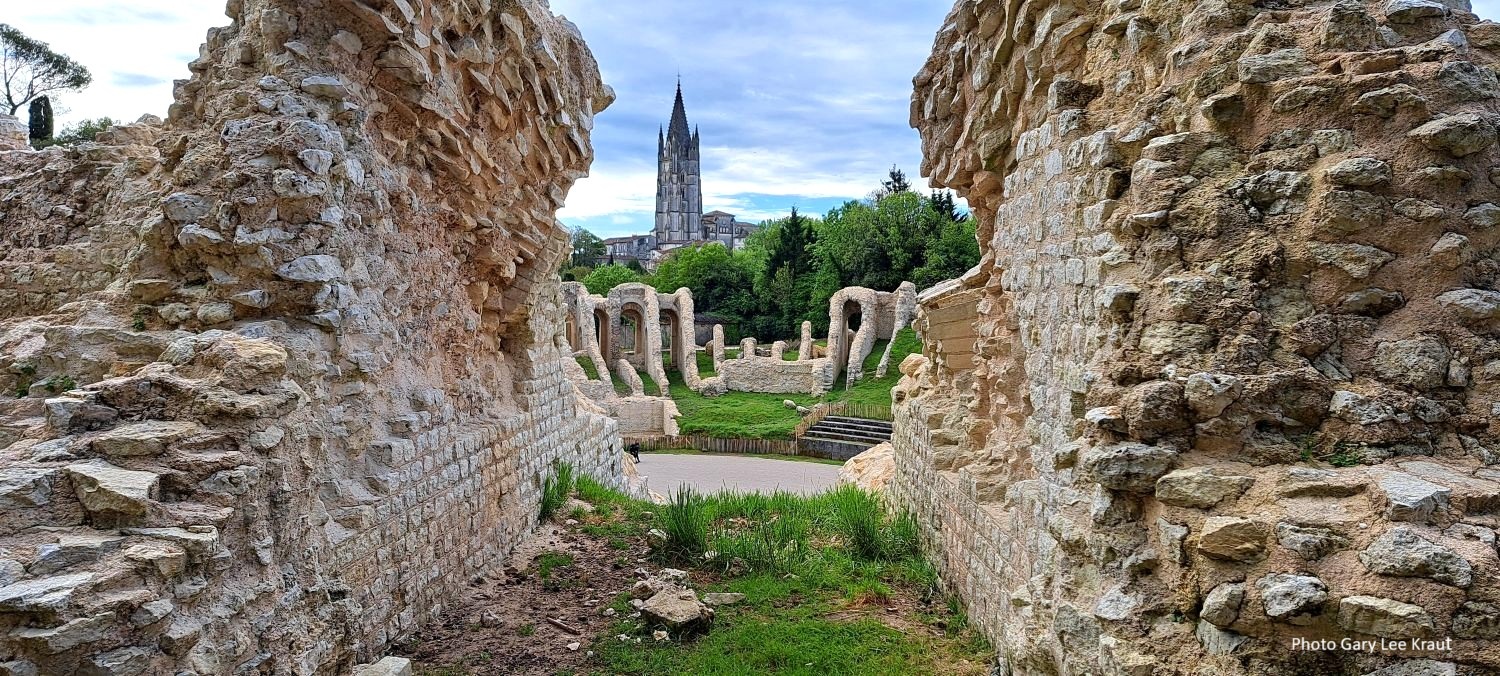
When Gary Lee Kraut visited Saintes, an often-bypassed town by a bend in the Charente River, he saw vivid remnants of Rome, the 2000-year-old hand of a mason, and an arch dedicated to an unruly hereditary gang. He met gladiators, fled from a saint’s crypt, slept in the cell of a medieval nunnery, wandered through a weird museum, and swirled vintage Cognac, all the while trying to decide if he could honestly recommend that anyone go out of their way to visit this New Aquitaine town.
If you look closely, very closely, at the masonry above the arch of the Gate of the Dead at the Roman amphitheater in Saintes, you can make out a fine line that indicates where a mason stopped his work for the day.
Unless a sign is eventually placed there, you won’t find the exact spot on your own. And even when Karine Robin, head of the archeology department for Charente-Maritime, points to and explains her discovery, I can’t be sure if I’m seeing the line or imagining it through her enthused description. I lean closer. Yes, there it is—eureka!—a trace of thrilling triviality within a Roman ruin in a bypassed town, shown by a proud and passionate archeologist. Astounding!
The minutia of the archeologist’s discovery and her vivid explanation light in my mind a spark that begins to illuminate the course of 2000 years of history, from a mason’s day in about 40 AD to the crowds who filled the amphitheater over the next four centuries or so, then the crumbling of the Roman Empire and the gradual transformation, dismantling and degradation of the amphitheater until archeologist began to study the partially buried structure in the 19th-century and now its fine-comb examination by Karine Robin and her team who have been investigating the site and restoring its remnants along with the National Institute for Preventive Archeological Research (Inrap).
That something so seemingly inconsequential in my own life—evidence of a Gallo-Roman mason leaving work for the day—should suddenly make a 3½-hour train ride from Paris feel worthwhile is in itself extraordinary. Often, the greatest reward of sightseeing isn’t a sight itself but the sparks that light in the mind when an informed person enthusiastically gives it context and teaches you how to look at it.
Would you go out of your way for that?
Probably not. You’ve already been the Colosseum in Rome, you say—impressive indeed. And to Arles and to Nimes, you say—yes, wonderful towns to visit. Me, too.
The Arena (Amphitheater)

Then what more can you find here when in fact far less remains of the cavea or seating area and far less of those wide passages that allowed for crowds to enter and exit? I scan the ruin. I listen to our guides. Those passages, we’re told, are called vomitories. Hearing that, a new spark illuminates the connection between the Latin spoken by Roman masons and emperors and the food poisoning I may have gotten from a 3-star Michelin restaurant several years ago. Like Helen Keller by the water pump and the tree, I want to the learn names of things. Those arched passageways to either end of the amphitheater are evocatively called the Gate of the Living (Porte des Vivants), on the eastern side, opening toward the city, and the Gate of the Dead (Porte des Morts), opening to the then-countryside to the west. It’s on the occasion of the restoration of the latter that Karine Robin has discerned the mason’s fine line. No, it isn’t only men who are intrigued by the history of the Roman Empire, though it could be that men are more susceptible to Roman sparks.
We’re visiting what is locally referred to as “the arena” but is technically speaking an amphitheater, i.e. a theater with seating on both sides. Not that I’ve become a connoisseur of Roman architecture in the past hour, but the traveler learns such things on site, and more: about the amphitheater’s religious, political and entertainment functions for a location population invited to witness wild animals in a hunting show in the morning, executions at noon, gladiator fights in the afternoon.
And there they are, on the theater floor today—gladiators! We go over to speak with them—well, the men in our group do. They aren’t real gladiators but strong and knowledgeable reenactors who perform here in summer. They present their shields and daggers, their metal helmets and leather padding.

There are no combats this afternoon, but we’re drawn in by their accounts of the lives of the trained fighters of ancient Rome. Today’s friendly gladiators now take evident pleasure in deflating our greatest sense of a gladiator fight: that it all ended with a life-saving thumbs-up or a deadly thumbs-down. We could have Googled “Roman hand signals” for details, but learning from reenactors who share their passion and knowledge right here on the theater floor makes think that I might have been a bit overdramatic yesterday when I complained to a friend about taking the 6:48am train from Paris.
 Then, just as I’m enthralled by an account of the glamorous and dangerous life of a hall-of-fame gladiator, we’re told that (Christian) Emperor Honorius prohibited gladiator combat in the year 404.
I look around at the grassy, rocky bowl that surrounds us, not to imagine the last of the cheering crowds but take in the pleasing view of sheep grazing on slopes that once held seating for up to 15,000 spectators, the town’s entire populations, all welcome, seated according to social status. And I sense the end of this amphitheater as a venue for the thrill of executed justice and violent entertainment. I sense the dismantling of temples, the surrounding of the city by ramparts, the rise of the Visigoths, the Sack of Rome.
Would you go out of your way for that?
I didn’t think so. But if there are remnants of a Roman amphitheater there’s got to be more to see in Saintes.
The name Saintes might lead you to imagine that the presence of a mother lode of Christian relics or a history of pious devotion, perhaps some memorable martyrdom. Though a certain Saint Eutropius was (for some, is) indeed venerated here as an early Christian martyr (I’ll get to him), Saintes is instead derived from the name of the Celtic tribe that inhabited the region at the time of the Roman invasion with Julius Caesar’s Gallic Wars and far before the evangelization of Gaul. They were the Santoni. Under Roman rule, the developing town was given the name Mediolanum, or Mediolanum Santonum to add the term for its inhabitants. (Similarly, the Parisii were the pre-Roman inhabitants of what would become Paris, a town the Romans called Lutetia or Lutetia Parisiorum.)
Mediolanum/Saintes developed just beyond a sharp bend in the Charente River. The town is now somewhat removed from major routes through France, hence the 3½ train from Paris with a change of trains at Angoulême. On the map below, you have to zoom in above and Bordeaux to locate Saintes along the Charente between Cognac, 17 miles to the east, and Rochefort, 24 miles northwest.
Two thousand years ago, however, Mediolanum held a proud place on the map of Gaul as capital of the large province of Aquitaine. Here, the east-west Via Agrippa, the route coming from Ludgunum (now Lyon), met the north-south route through Aquitaine, a sign of the town’s geographical and political importance.
The amphitheater is testimony to the town’s prominence early in the Roman colonization of Gaul. Completed in about 40 AD and dedicated to Emperor Claudius (41-54 AD), who had been born in Lugdunum, its construction predates that of the Colosseum of Rome by about 30 years and that of the amphitheaters of Arles and Nimes by 50 and 60 years respectively.
Bordeaux would take over as the capital of Roman Aquitaine in the 2nd century, leaving Mediolanum with a secondary role, then less so as centuries passed. Saintes is now a part of the vast region of New Aquitaine, whose capital is Bordeaux. Its current population is only 27,000 (56,000 with the metropolitan area), less than double what it was 2000 years ago. Its inhabitants are called the Saintais and Santaises.
The Arch of Germanicus
Even before the construction of the amphitheater, Mediolanum bore the proud markers of a Roman town.
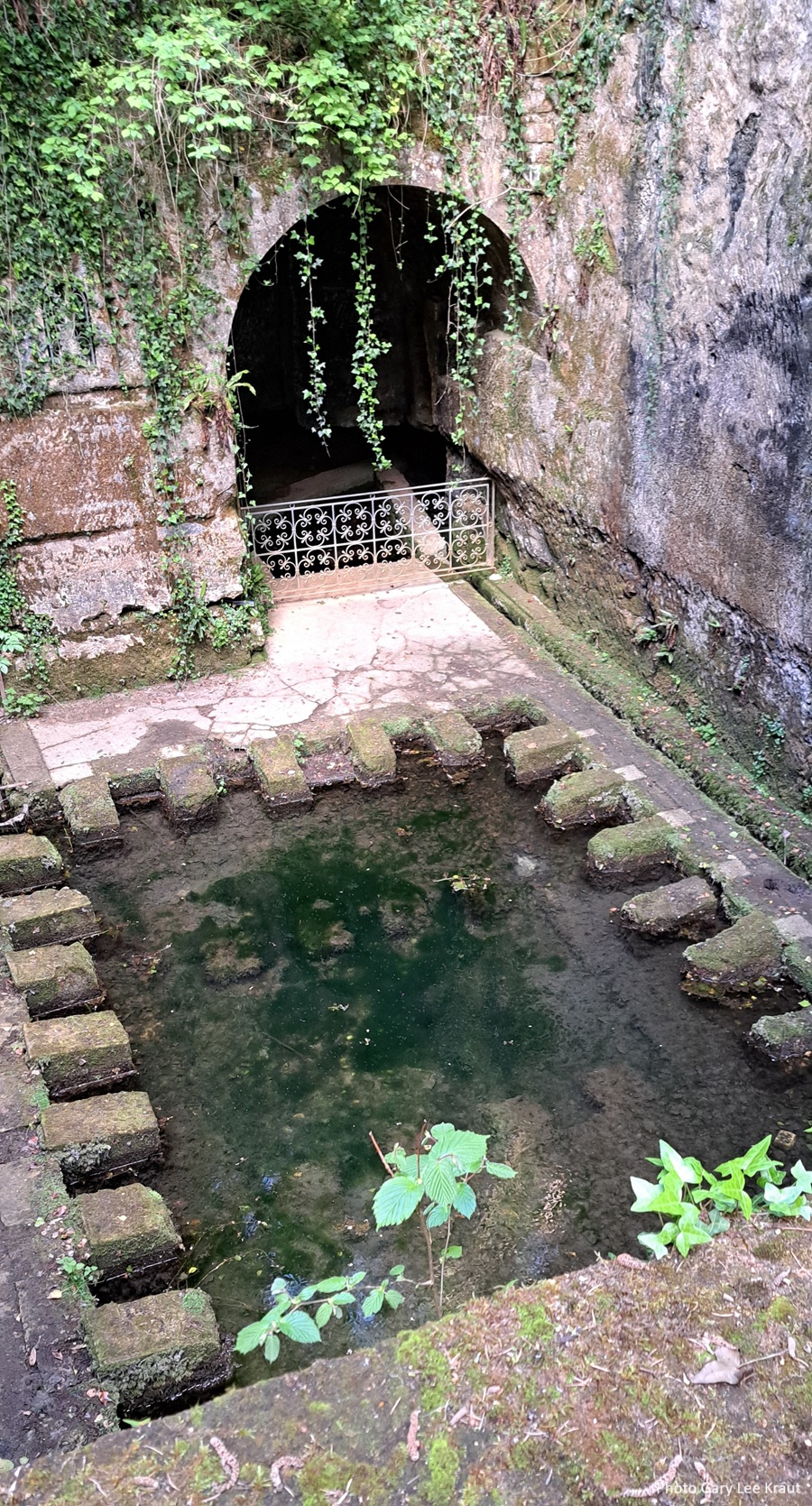
Its first aqueduct was already supplying water, and a second would soon be added to provide a more abundant supply to the growing provincial capital. Remnants of these can be seen at their sources in the countryside 6-7 miles outside of town. Fascinating as they may be, it’s likely that only a diehard explorer of antiquity with a vehicle will inquire the route at the tourist office to seek them out.
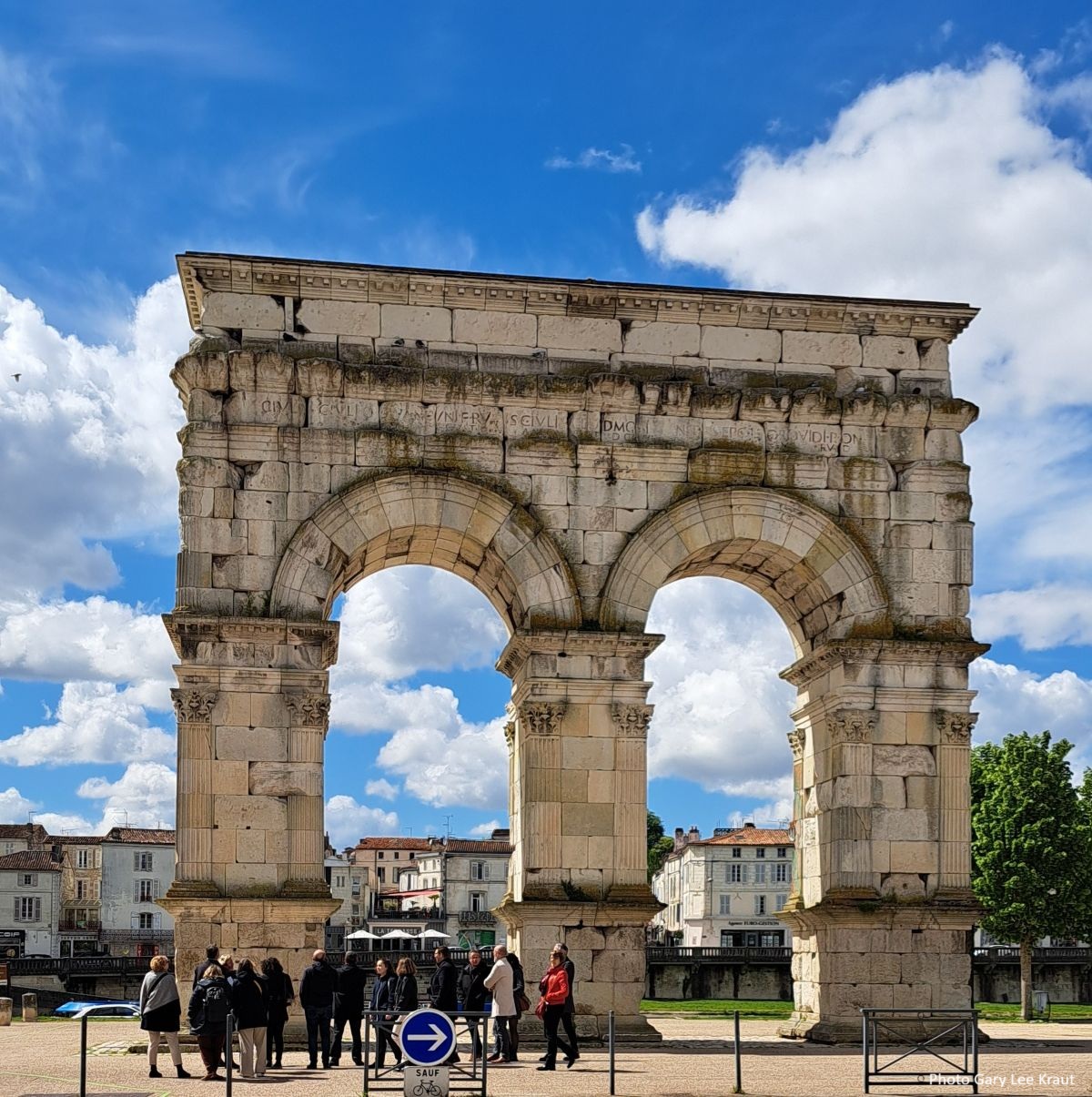
Every visitor to Saintes, however, takes a walk along the river to see the Arch of Germanicus, built about 18-19AD. (Also, the tourist office is close by.) Originally constructed at the point of arrival of the Via Agrippa, the arch was the entrance gate to the bridge crossing the Charente into the heart of Mediolanum. The double-arch gate honors Emperor Tiberius, his son Druus and his adoptive son Germanicus, yet Germanicus gets sole reverence today since his name is the most legible of those inscribed along the arch’s crown.
In 1843, the arch was displaced 150 yards from its original position as the bridge and waterfront were modified. So it now stands isolated and out of context, diminishing some of its aura. Nevertheless, as we stand by the river with a full view of the arch and learn from Cécile Trébuchet, a dynamic local guide, how to interpret its blocks and inscriptions, visiting Saintes feels less like a detour and more like an arrival. It also inspires a wiki read about Tiberius and the imperial gang of 2000 years ago that later sends me down the rabbit hole of Roman history from which I eventually emerge with the sense that the same gang is at it today.
A visit to the town’s Archeology Museum, right nearby, seems like the natural next step. Unless it’s mealtime, in which case consider the restaurant barge La Batiâ that’s docked by the arch.
Would you go out of your way for that?
Unlikely. Maybe a medieval monument or two will tilt the balance. Three medieval bell towers stand out above the pale red tile roofs of Saintes, those of the Abbaye aux Dames (the Ladies’ Abbey), of Saint Pierre (St. Peter) Cathedral and of Saint Eutrope (Eutropius) Basilica.
The Tomb and Crypt of Saint Eutropius
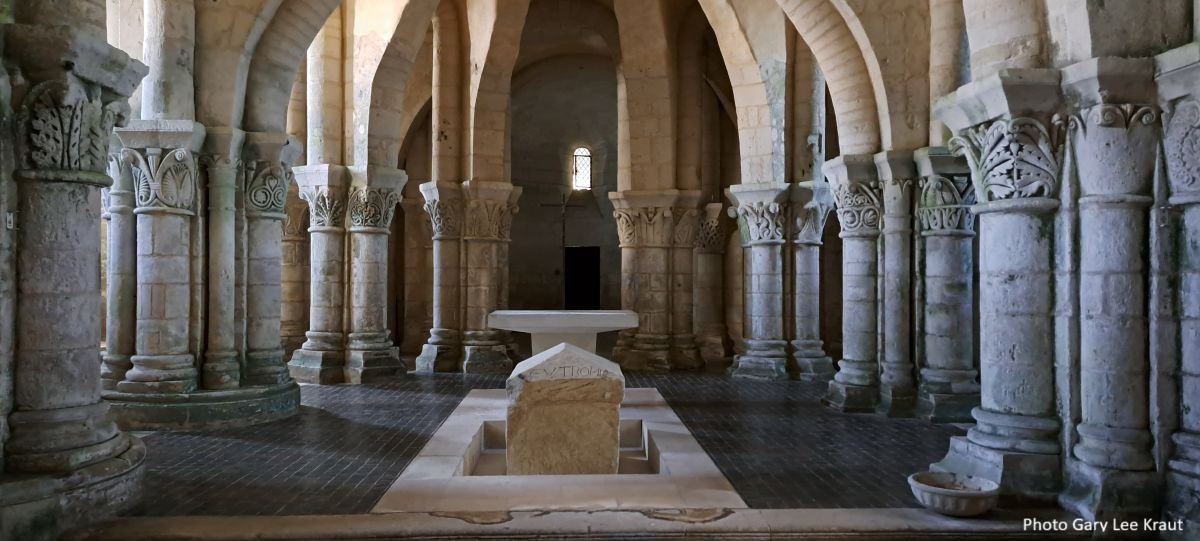
Saintes’s most unique medieval sight is the basilica’s crypt, a subterranean church containing the tomb on the early Christian missionary and lapidated martyr Saint Eutropius. A site of devotion since the mid-500s, the presence of the saint’s tomb later earned Saintes a stop on the Way of Saint James to Compostella, Spain. The tomb now lies in dramatic simplicity in the heart of a vast crypt of the 11th century. The light, the chill and the musty smell there create a spectacular and eerie atmosphere that flirts between virtuous intimacy and the possibility of eternal damnation, as the most titillating flirts do. It’s open to the public, if you dare enter the gaping mouth of the entrance to the great below. The leafy decorations of its column capitals provide touches of charm that partially alleviate the sense that the end is nigh. But be forewarned: Stand inside alone for more than a few minutes and you’ll either fall to your knees in a desperate plea to be saved or run out in a panic to save yourself. I chose the latter.
The Ladies’ Abbey: Hotel, Church, Music Conservatory
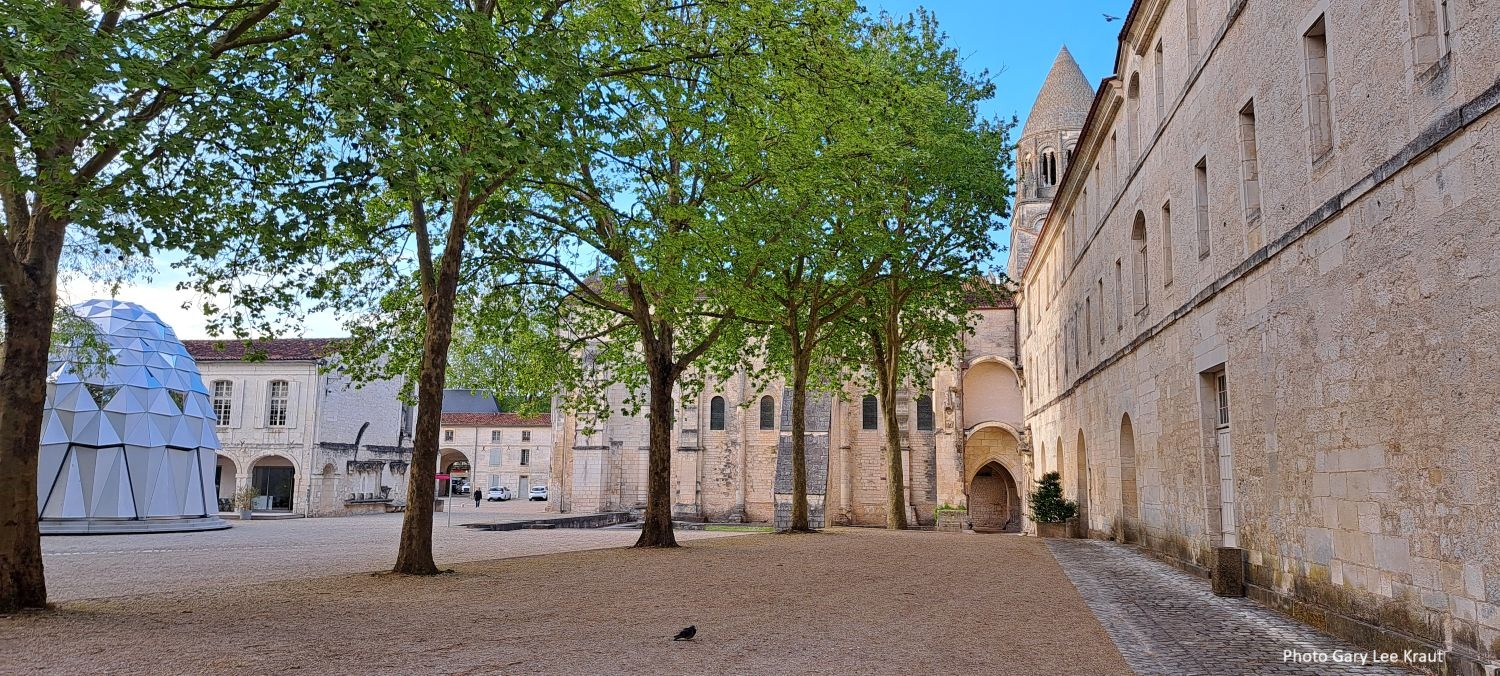
You’d be hard pressed to find a tourist trap in Saintes considering how few foreign tourists venture this way. That point alone can be the attraction as an overnight for the wayward traveler, or for someone suddenly struck with wanderlust, or for a cyclist on the easy-going Rochefort-Cognac leg of the Flow Vélo route. Consider then a peaceful night at the Abbey aux Dames, the Ladies’ Abbey, which is also a highlight for the day visitor.
Founded in 1047, the Ladies’ Abbey, is a successful contemporary example of ways in which heritage sights can be rehabilitated to the benefit of local life, local economy, culture, and visitors. While one portion of the complex is now used for social housing, the central portion houses a music conservatory, an auditorium and a hotel, along with the abbey church. The complex also has an information desk, a boutique, a café and a strange playable musical tent of sorts.
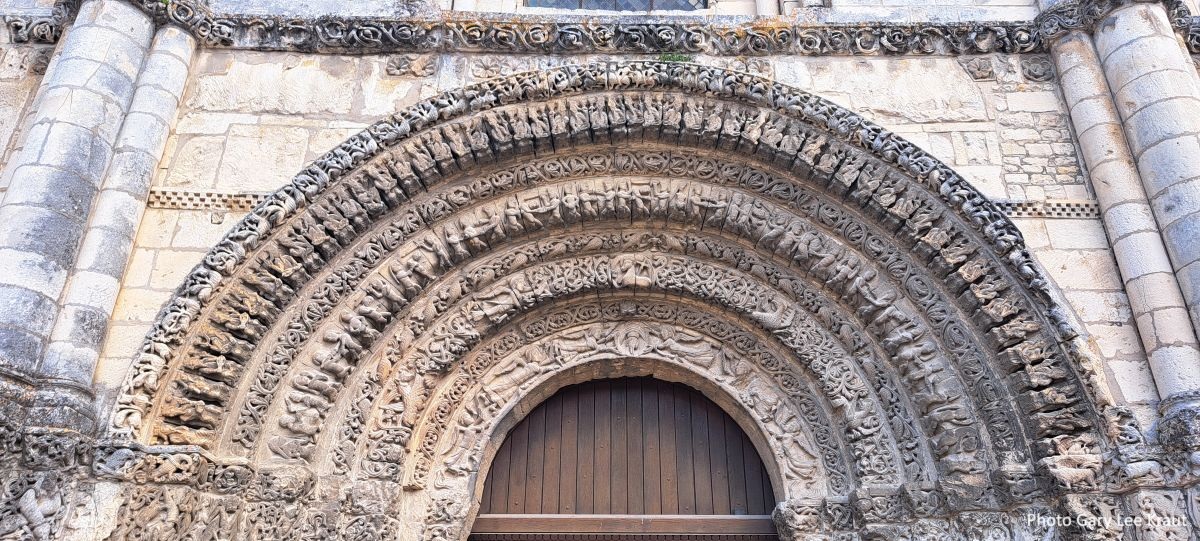
The abbey church remains the medieval centerpiece. Though the Benedictines nuns were sent packing during the Revolution, the Romanesque church was later reconsecrated and continues to hold Catholic service. Fires in 1608 and 1648 led to the rebuilding of the convent buildings in the 17th century. From the Revolution until just after the First World War, the site served as military barracks, housing about 2000 men. Audio guides are available to explore the thousand-year history of the site and to appreciate its recent musical vocation.
In 1972, the tired complex was given new life when it became the venue for a Classical music festival. The former abbey now hosts musical programs throughout the year, culminating in the annual Festival de Saintes. In 2025, nearly 12,000 people attended the 29 concerts performed over 8 days in July at the abbey and elsewhere in Saintes.
Situated between the station and the river, the abbey hotel is conveniently situated for lodging train travelers and bikers.
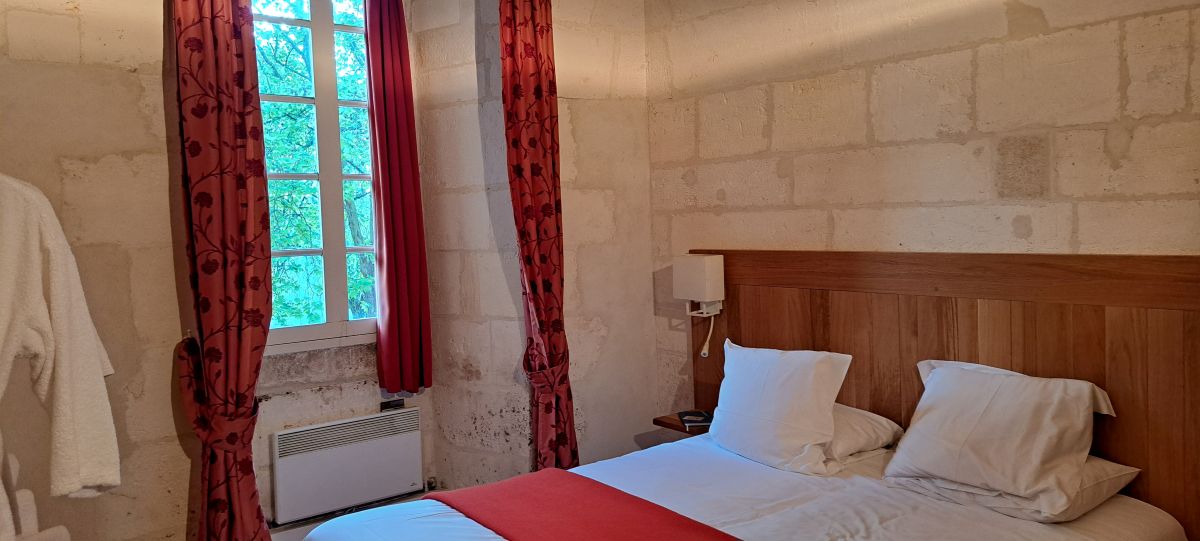
The 33 bedrooms occupy the former cells of nuns along a hallway on the second floor of the main convent building. Only several of the rooms have en suite bathrooms. Most share bathrooms on the hallway (bathrobes and slippers are provided). That will be off-putting for some, but will add a sense of community to others.
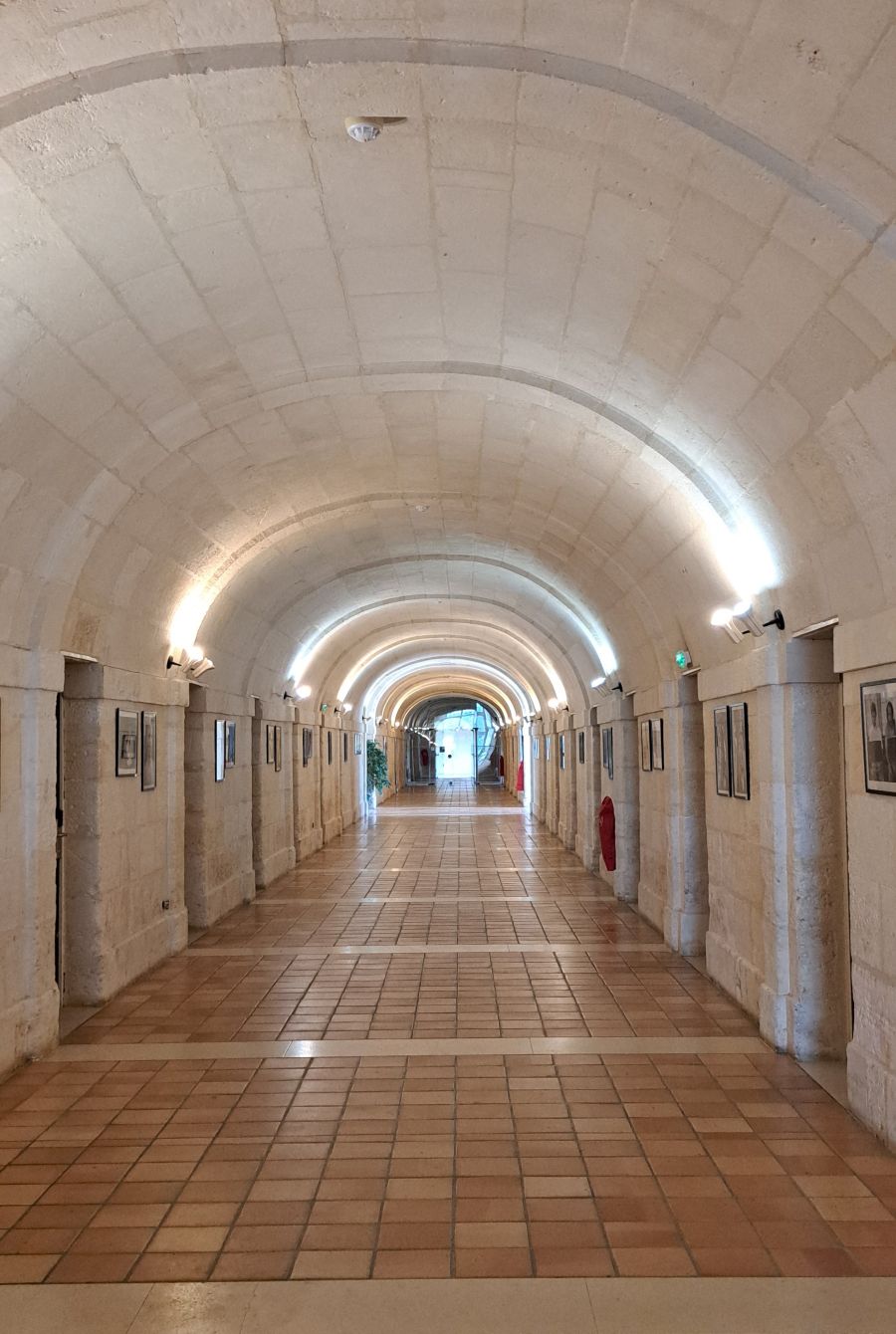
The hotel is not for ladies only, and this is not roughing it. The rooms are comfortable. The architecture itself is the primary décor. The quiet of the immediate surroundings, the history of the place, and the arched stone-and-brick ceiling of the bedrooms inspire guests to sleep the sleep of nuns or soldiers or Classical musicians or tired tourists, depending on what dreams, nightmares or fantasies overcome you. About 100€ per room per night is a reasonable price to find out. The complex is open year-round, however the hotel section primarily operates April to September. The rest of the year it opens only for groups reserving 10 rooms or more.
Other nice lodging options for train travelers or cyclists include Hotel des Messageries, a 3-star by the river and the town center, and La Porte Rouge – The Red Door Inn, a charming B&B in the center. Those traveling by car may also consider Relais du Bois Saint Georges, a 4-star on the edge of town.
The Dupuy-Mestreau Museum
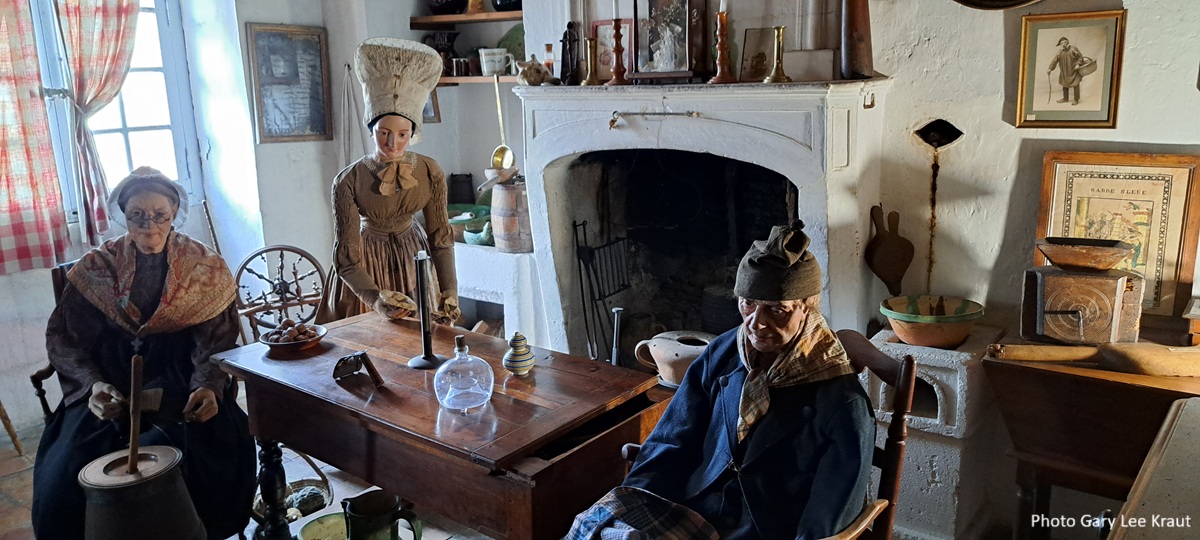
It’s from a side street that we enter this handsome private mansion of the 18th century that otherwise faces the Charente River. In the 19th century the mansion was purchased by Abel Mestreau (1855-1939), a wealthy Cognac merchant and a collector of regional folklore, curiosities and apparently whatever struck his fantasy. He never actually lived here. The Dupuy-Museum Museum is so scarcely visited and the discolored collection is so eclectic that that itself may appeal to those who like feeling that they’ve left main-road travelers way behind.
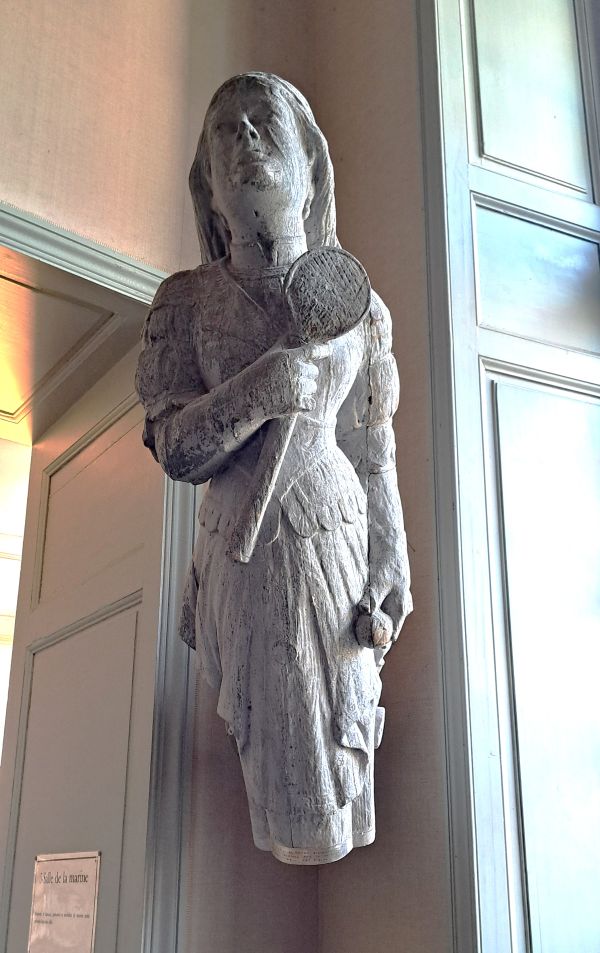
As much as I appreciate having our guide explain the interest of the various costumes, clothing, regional headdresses (coiffes), paintings, regional artefacts, furnishings, knick-knacks, pottery, jewelry, and what-the-heck-is-thats, I also enjoy wandering around on my own so as to make up stories about various objects, e.g. this gal with the racket; I call her the goddess of tennis. Not unlike visiting Saint Eutropius’s crypt, eclectic regional museums such as this inspire in me a mix of intense curiosity and a desire to flee.
Curiosity got the better of us all. We hung around long enough to see the royalist treasure among the footwear display: a cute pair of slipper-shoes said to have been worn by deposed king Louis XVI during his imprisonment, as he awaited the trial that would eventually lead to his execution. I’m glad I saw them, because that gives me a reason to tell you a Saintes fun fact: Saintes was the birthplace in 1738 of Joseph-Ignace Guillotin whose name lives on in the term for the machine for humane and expedient execution that he championed: the guillotine. An etching of the fellow is among the collection.
Would I advise you to go out of you way for that or does this sound like a far way to go for yet another quaint small town in France?
Still wondering.
Cognac Grosperrin
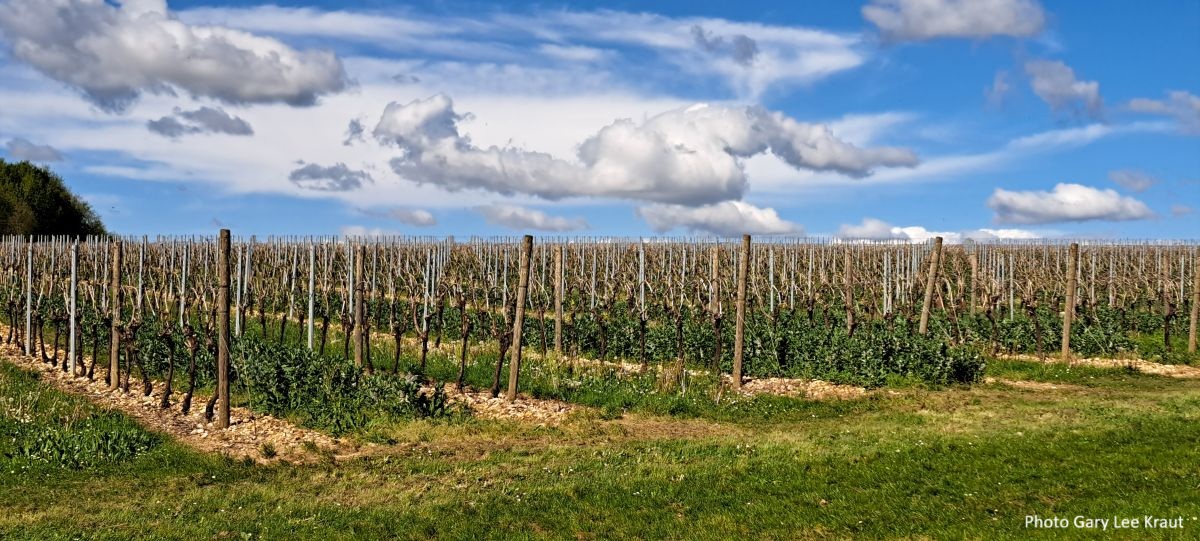
After all of the vestiges and artefacts that we’ve encountered through the day, we air out our dusty minds with a stroll along the river. It leads us to the offices and cellars of Saintes’s last remaining Cognac broker. As we approach, we imagine barges docked nearby to load casks for shipping when these cellars were first operational in 1851.
Cognac, the town that gave its name to the world-renown double-distilled brandy, is 17 miles upriver, to the east, yet Saintes lies within the cognac grape-growing zone. While most of the major players in the Cognac market are in and around Cognac, the Grosperrin Cognac house, located here, is increasingly known to connoisseurs. Since 1999, first under Jean Grosperrin then, beginning in 2004, under his son Guilhem, Cognac Grosperrin has made a name for itself by purchasing from a variety of sources single-terroir and vintage Cognacs in oak casks, which it then continues to age before bottling and selling at what it deems the appropriate time.
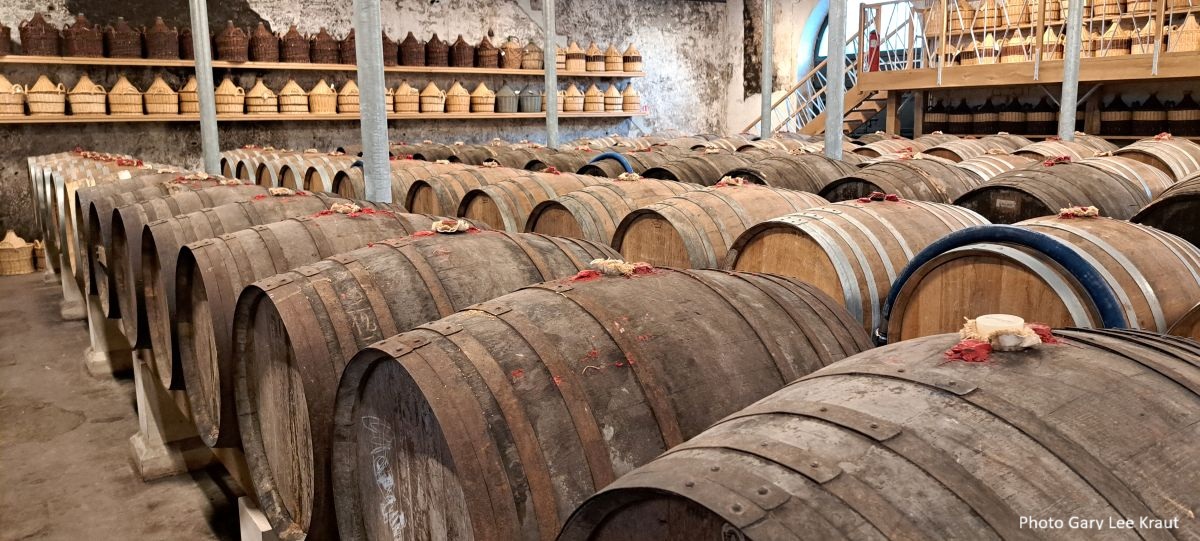
The main cellar, with its old casks and demijohns, most of which are dated and authenticated with official sealing, is an impressive sight in its own right when one thinks of the history (your own, France’s, the world’s) that the dates represent. Then comes the tasting.
I will admit here that among French brandies I never had a taste for Cognac, finding it too harsh for my palate. Before now, that is. Turns out that my impression was based on middling or young Cognacs, the kind best reserved for cocktails or give-me-anything-that-burns digestives. When well-selected fruit is well-distilled and well-aged, it’s an entirely different experience. The same can be said for Calvados (apple) and Armagnac (grape), the two other internationally known French brandies, but I’ve generally been more forgiving when sipping middling versions of those, on the one hand because I’m a frequent visitor to the Calvados region of Normandy and accept that apple brandy is a unpretentious spirit, and on the other because the Armagnac-producing region of southwest France is so enchantingly rural. One reason that I didn’t write about the town of Cognac after a quick visit there ten years ago was that I couldn’t quite wrap my tongue around its namesake brandy. I now realize that I need to go back and try again, because one sip—one spark—of a vintage offered by out tasting guide Maxence le Moulec at Grosperrin and I find myself wondering where I can buy a nice set of crystal brandy glasses. A sip of another and I’m thinking of purchasing a set of leather armchairs. One more and I’m considering looking for an apartment with a working fireplace.
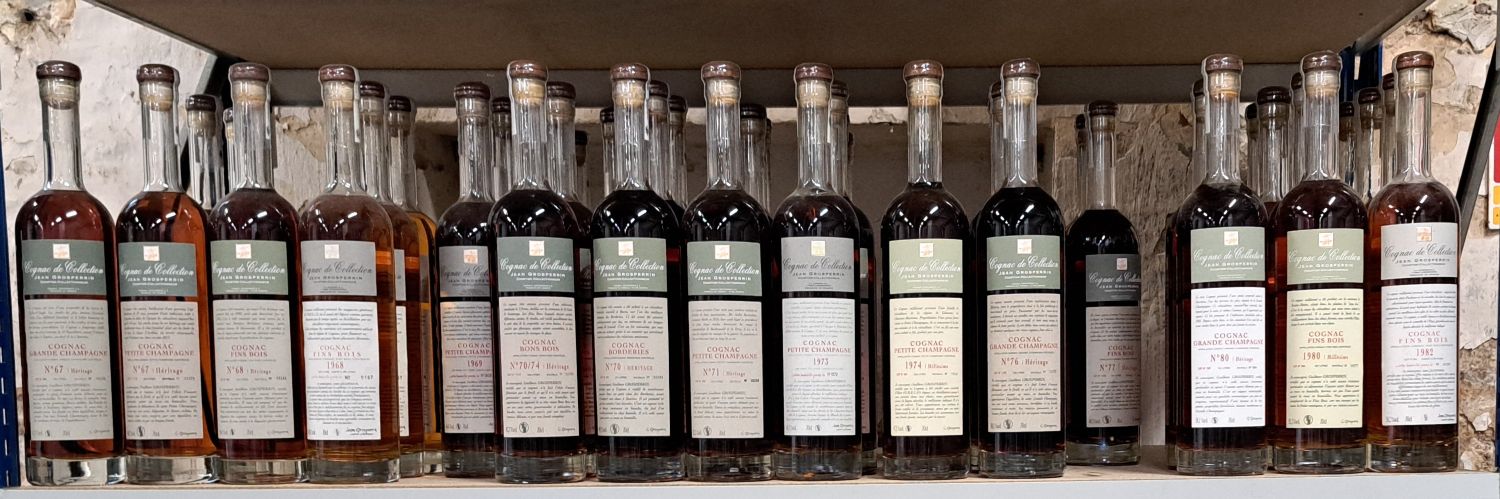
Grosperrin isn’t only a connoisseur’s Cognac. It can also be a Cognac for infrequently imbibing non-connoisseurs who would enjoy splurging for a quality bottle that will last a while, or for someone who already owns a set of leather chairs and crystal tumblers but not the brandy to go with it, or, finally, someone who may never buy a bottle Cognac but wants a sip of local heritage excellence while traveling in the region. Even a sniff-swirl-and-spit tasting may suffice to understand the meaning of carpe diem, as the Roman poet sang. Let’s take this opportunity to recall what the Roman playwright said: “Moderation in all things is the best policy.”
For 7€, visitors are welcome for a tour and tasting. More intense and in-depth tasting tours can be reserved for 45€ and 150€. Advance booking is advised. Grosperrin isn’t the only merchant to go for quality in the Cognac-producing region, but I give them their due for sparking my interest in Cognac.
Is Cognac too harsh for you? Try Pineau des Charentes when in the region. Pineau is a fortified wine of about 17% in which grape juice (white, red or rosé) and Cognac are mixed and aged on oak barrels to create a sweet aperitif, served chilled. Don’t drink? Savor the food stands at the Saint Pierre Market on Wednesday and Saturday mornings.
So would I recommend that you go out of the way for Saintes?
I thought about the question on the long train ride back to Paris. How could I possibly give a generic answer? To each his or her own sparks, interests, imagination and cheap thrills. But don’t readers deserve an answer, a proverbial thumbs-up or thumbs-down or an algorithmic 1 to 5 stars? Was there something special here or was this just another quaint old French town? And if the latter, isn’t that enough?
I thought of all I’d done: I’d met archeologists and gladiators, learned history and words, descended into an eerie crypt, slept in a nunnery, wandered around a bizarre museum, nipped Cognac. Then suddenly, in a spark, I imagined Julius Ceasar, pleased, contemplative and exhausted on his way home from the Gallic Wars that would change the course of history all along this train route. I felt just like that. I came, I saw, I conked out.
© 2025, Gary Lee Kraut
Read about two other towns in the department of Charente-Maritime in New Aquitaine, Rochefort and La Rochelle.